 EN
EN ES
ES FR
FR RU
RU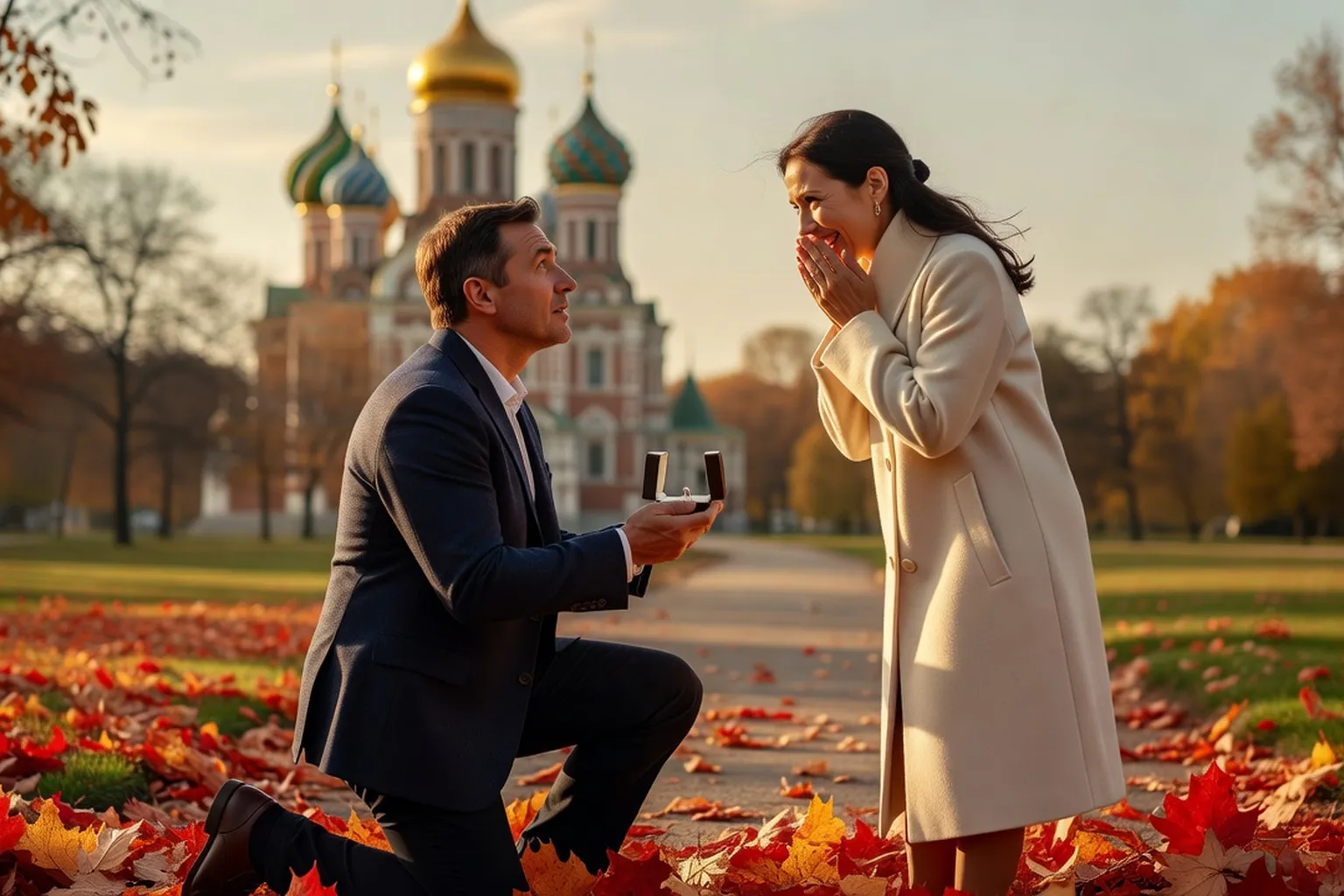
Proposing marriage to a Russian woman is not the same as proposing to a Western one. The gesture itself looks similar — a knee, a ring, a question — but the cultural foundation underneath it is built from a very different material. Family approval, timing, the role of words, the symbolism of the ring, and the way the moment is shared with relatives all follow rules that Western men rarely learn until they get them wrong.
This guide gathers what experienced matchmakers, Franco-Russian couples, and intercultural psychologists have learned about marriage proposals to Russian women in 2026. It is written for the man who has met someone real and wants the moment to land the way he intends. By the end, you will know what to do, what to avoid, and why the small choices matter more than the grand ones.
Why Proposing to a Russian Woman Requires Cultural Preparation
In Western dating culture, the marriage proposal is often framed as a private moment between two individuals. The couple decides, sometimes informally, that they are ready; the proposal seals a decision they have already made together. Russian culture treats the moment differently. The proposal is a public commitment that connects two families and confirms a man’s seriousness — not just to her, but to her mother, her grandmother, her closest friends, and sometimes her father.
This is why a proposal that feels touching to a Western audience can feel hollow to a Russian one. A man kneeling alone with his partner on a beach in Bali, no family informed, no parents consulted, may be following his own script — but he is also signaling, without realizing it, that he sees marriage as a private contract rather than a family bond. For many Russian women, that signal is a quiet warning sign.
The cultural preparation is not complicated. It requires three things: knowing her family, choosing the right moment in the relationship’s arc, and finding words that carry weight. Done right, the proposal becomes a beginning. Done casually, it becomes the first chapter of a long misunderstanding.
For context on the broader cultural framework that shapes Russian women’s expectations, our complete Slavic brides guide covers the family-centered values that inform every step of courtship.
Before the Proposal: Three Foundations You Cannot Skip
1. Meet Her Parents in Person at Least Once
The single most predictive factor for a well-received proposal is whether you have met her parents in person. Video calls are appreciated but they do not replace the in-person visit. The visit does not have to be elaborate. A weekend, a shared meal, a conversation about your work and your family — that is enough to anchor the relationship in something concrete.
Russian parents do not expect you to speak Russian fluently or to know every tradition. They expect you to show up. The visit is read as a statement: you are willing to enter our family on our terms, not just on yours. This single step removes more friction from the proposal than any ring or location ever could.
If geographic distance makes a visit impossible before the proposal, organize a serious video meeting where you explain your intentions clearly. Send a gift in advance — flowers for her mother, something thoughtful for her father. Then commit to an in-person visit within the engagement period. The sequence matters: you signal seriousness through actions, not promises.
2. Respect the Timeline
Russian women assess long-term compatibility carefully. A proposal at 3 months — even when sincere — almost always reads as either rushed or instrumental. The cultural baseline is closer to 12 months of serious, committed relationship before the proposal makes sense.
Three categories shift this baseline:
- Women under 30 in major cities often expect a clearer commitment around month 12. Beyond 18 months without movement, the relationship starts to lose intensity.
- Women in the diaspora — those who have lived 5+ years in Western Europe or North America — often have hybrid expectations. They appreciate a Western pace but still expect family integration before the proposal.
- Mothers and women over 35 typically want a longer observation period. 18 to 24 months is not unusual, and they take the engagement period itself more seriously.
The fastest way to read the timeline correctly is to ask her directly, sometime during month 6 or 7, where she sees the relationship going. Russian women appreciate that question when it is asked sincerely and not as a tactic.
3. Choose the Ring With Symbolism in Mind
The engagement ring carries more cultural weight in Russia than in many parts of Western Europe, though less than in the United States. A real ring matters — costume jewelry is not received well even as a placeholder. Yellow gold remains more traditional than white gold or platinum, though urban women under 30 increasingly accept both. A simple solitaire diamond between 0.3 and 0.7 carats sits in the realistic mid-range for 2026.
The size of the stone is far less important than the authenticity of the gesture and the precision of the moment. A modest ring presented with thoughtful words almost always lands better than a large ring delivered casually. Russian women, especially those who grew up in the post-Soviet years, value sincerity and effort over visible expense.
If your budget is constrained, communicate that openly. A heritage ring from your family — a grandmother’s ring resized — often carries more emotional weight than a new purchase. The story behind the ring is part of its value.
The Proposal Itself: Location, Words, Ring
Choosing the Right Setting
City-raised Russian women under 35 often welcome a tasteful public proposal. A restaurant with view, a scenic park, an apartment carefully prepared with candles and music — these all work well. The setting should feel curated, not improvised. A proposal in a fast-food restaurant or in transit reads as careless, no matter how heartfelt the words.
Women with more reserved personalities or traditional values prefer a private moment — the two of you, no audience. Read her past reactions to public attention. If she lights up when she is the center of a room, a tasteful public proposal will work. If she retreats from spotlights, choose the privacy of a meaningful place.
Some couples now organize a proposal in the home where she grew up, with family present but discreet. This works beautifully when the family relationship is already strong. It signals respect for her origins and turns the moment into a family celebration.
Words That Land
The words matter more than any other element of the proposal. Russian women want to hear specific reasons why they are chosen, not generic phrases. “I love you and want to spend my life with you” is a sentence that exists in every English-language film and carries almost no weight on its own. The personalization is what makes the words real.
A proposal that lands typically includes three elements:
- A specific memory. The moment you knew, told as a short story.
- A specific commitment. Not “I will love you forever,” which is abstract, but something concrete — how you will support her career, her family, her dreams.
- A specific question. Not “Will you marry me?” alone, but the question framed in the context of what you are building together.
If you do not speak Russian, learn one sentence: Будь моей женой (Bud moey zhenoy — “Be my wife”). Say it imperfectly. The effort itself is the message.
Presenting the Ring
Present the ring after you have spoken, not before. The ring without the words is a transaction. The words without the ring are a wish. The sequence — words, then ring — is what transforms the moment into a proposal.
For couples planning more detail on every cultural step, our 10-question cultural guide interview with Dr. Katia Volkov, Franco-Russian psychologist, walks through the specific pressures Western men face in the weeks before proposing.
After She Says Yes: The First Three Calls
The hour following a proposal carries its own protocol. Three calls matter:
- Her mother first. Within an hour, ideally with her on the line, you call her mother together to announce the engagement. This single gesture closes a thousand small doubts that may have lingered in her mother’s mind.
- Her father second. Even if you are not close, this call is a marker of respect. Brief, clear, formal in tone.
- Your parents third. Your own family announcement can wait if needed — her family takes priority because the cultural sequence is family of the bride first.
The engagement period that follows is itself a stage of the relationship, not just a waiting room before the wedding. Russian families often celebrate the engagement formally — a pomolvka dinner, sometimes with extended family. Participating wholeheartedly in that celebration signals that you understood the cultural transition you just made.
Seven Mistakes Western Men Make When Proposing
- Proposing too fast. A proposal in month 4 or 5 reads as immature, no matter how genuine. Even when she says yes, the family will be skeptical and the engagement will start fragile.
- Skipping the parental meeting. Whether by oversight or convenience, this is the single most damaging shortcut. Mothers especially never forget it.
- Public proposals when she is private. A stadium-style proposal for a quiet woman creates a humiliating moment, not a romantic one.
- Generic words. Sentences from films, recited under pressure, read as borrowed. They reveal that you did not prepare.
- A placeholder ring presented as “the real one.” Costume jewelry as a stand-in is read as disrespect, even if intended as a temporary solution. If the budget is limited, present an authentic modest ring and explain.
- Treating the engagement as a logical step. Russian culture frames the proposal as an emotional declaration. A man who treats it as a checkbox in a relationship plan signals that he sees marriage as a contract, not a bond.
- Forgetting to call her mother. A small detail that creates a permanent emotional gap if missed.
Real Cases: How It Actually Plays Out
The matchmaking files at serious international agencies — such as those tracked by CQMI, a Franco-Canadian matrimonial agency active since 2003 — offer hundreds of small stories. Three patterns recur:
- The Lyon-based engineer who proposed at his fiancée’s grandmother’s apartment in Krasnodar, with the grandmother present. Modest ring, learned three sentences in Russian, called his fiancée’s mother within an hour. Five years married now, two children.
- The Frankfurt accountant who proposed at the Eiffel Tower with cameras rolling and zero parental contact beforehand. The proposal went viral; the engagement broke six weeks later when the family pressure became unbearable.
- The Montreal entrepreneur who proposed twice — the first attempt at month 5 was politely declined; the second attempt at month 14, after spending Orthodox Christmas with her family, was accepted. He sometimes jokes that the first proposal taught him more than the second.
The pattern is clear. Time, family, and specific words matter more than location, ring size, or spectacle. To extend your understanding of who Russian women are and what they expect from a serious partner, our long-form essay on why Western men misunderstand Russian women for marriage walks through the deeper cultural codes.
Quick Pre-Proposal Checklist
Before you propose, you should be able to answer yes to each item:
- I have met her parents in person at least once.
- We have been in a serious relationship for at least 8 months, ideally 12.
- I know what she expects from married life — children, location, careers, religion.
- I have chosen a real ring, even if modest, and I know what it will mean to her.
- I have prepared specific words, not generic phrases.
- I know how she will react to the setting I have chosen.
- I have a plan to call her mother within one hour of the yes.
- I have considered, honestly, whether I am ready for the engagement period and the wedding that follows.
If any answer is no, wait. The proposal is not a finish line — it is a door. You only get to open it once.
For couples thinking about the practical road ahead — including immigration and visa questions — our matrimonial agency guide for 2026 covers the full path from first meeting to international wedding. And for men considering meeting Russian women in France through verified networks, the Russian women in France guide on Les Femmes Russes is an excellent companion resource.
A marriage proposal is one of the few moments where the cultural codes you respect become more important than the gesture you invent. With Russian women, those codes are clear and have not changed much in a generation: family first, words that mean something, a ring that is real, and time taken seriously. Get those four elements right and the rest takes care of itself.
Frequently Asked Questions
What is the most important step before proposing to a Russian woman?
Meeting her family at least once in person, ideally twice. Russian culture treats marriage as the joining of two families, not just two individuals. A proposal made without that step often feels reckless to her and to her parents, even when she is independent and lives abroad. Visit, share a meal, demonstrate that you take her family seriously — then propose.
How long should I date a Russian woman before proposing?
Between 8 and 18 months in most cases. Russian women under 30 in major cities tend to expect a clearer commitment after 12 months. Older women, women in the diaspora, and women who are mothers tend to want a longer observation period — 18 to 24 months is not unusual. Proposing before month 6 almost always reads as either naive or transactional.
Do I have to ask her father's permission first?
The classic 'permission' formula has faded for women under 35. What replaces it is a clear conversation — informal but explicit — where you tell her parents you intend to marry their daughter. This is not asking for permission, it is announcing intent and showing respect. Skipping this conversation is the single most frequent grievance Russian mothers report to matchmakers.
What kind of engagement ring do Russian women expect?
A real ring, presented sincerely. The stone does not need to be large but it must be authentic — costume jewelry is a deal-breaker. Yellow gold remains more traditional than white gold or platinum. A simple solitaire diamond between 0.3 and 0.7 carats is the realistic mid-range expectation in 2026. What matters most is the gesture and the words around it, not the karat count.
Is a public marriage proposal a good idea?
It depends entirely on her personality. City-raised Russian women under 35 often welcome a tasteful public proposal — a restaurant, a scenic viewpoint, sometimes the home she grew up in with family present. Women with more reserved personalities or traditional values prefer a private moment. The safest approach: know her preferences before deciding. A flashy stadium-style proposal almost always reads as performative and is rarely well received.
Should I propose in Russian or in English?
If you do not speak Russian fluently, propose in your shared language but learn one full sentence in Russian — typically 'Будь моей женой' ('Bud moey zhenoy', meaning 'Be my wife'). Saying that one line, even imperfectly, communicates respect, effort, and an intention to bridge the two worlds. Russian women remember that sentence for the rest of their lives.