 EN
 ES
 FR
 RU
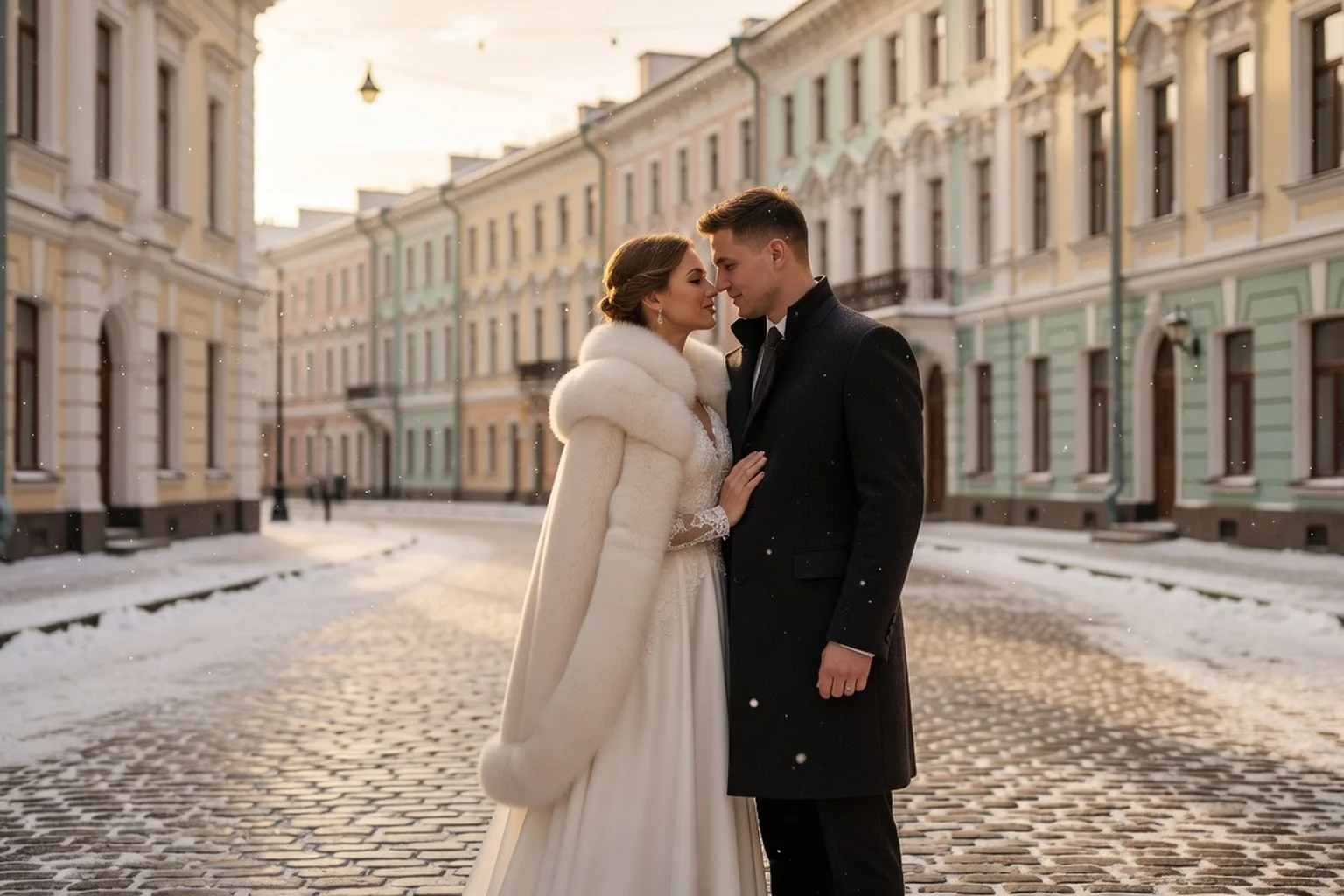
Yes — a winter wedding in Russia is not a compromise, it is a different genre. Snow turns Moscow and Saint Petersburg into backdrops no florist can build, venues that are booked solid from May to September suddenly negotiate, and the season’s traditions — the fur shuba, the troika sleigh, the karavai shared in a candle-lit hall — belong to winter the way champagne belongs to midnight. The one thing winter demands is respect for the clock: in mid-December Moscow gives you barely six hours of daylight. This guide covers which traditions to keep, how to build the day around the short sun, what it realistically costs in 2026, and where to spend the honeymoon.
Why winter is Russia’s most underrated wedding season
Most international couples default to summer because that is what their home countries do. Russia rewards the opposite instinct. Historically, winter was a favored wedding season: after the harvest the village had time, stored food, and no field work, and some communities deliberately scheduled weddings between Christmas and New Year. The folk calendar also warns against May — mai echoes maiat’sia, “to suffer,” so a May bride was said to marry a lifetime of toil — while late January and February carry no such superstition.
The modern advantages are more concrete. Venues, photographers, and hosts are saturated in the warm months; in January and February they compete for you. Winter décor needs less: candlelight, evergreen, deep colors, and velvet read as luxury in a way that feels forced in July. And a snowfall the night before the wedding is worth more than any rental budget — snow-covered streets, fur collars, and breath in the air photograph like a film set.
The trade-offs are real but narrow. Average temperatures run around −6°C in Moscow and −4 to −5°C in Saint Petersburg in December, colder in January. Snow cover is usually stable in both cities from late November or December through March. None of this happens outdoors for long — and that is precisely why the schedule below matters.
For the full background on what a Russian wedding means — the ZAGS civil registration, the optional Orthodox crowning, the roles around the couple — our guide to Russian wedding traditions and the Orthodox ceremony is the companion to this one. Winter changes the logistics, not the meaning.
The traditions that make a winter wedding Russian
The customs that matter most are not winter-specific, and that is good news: they anchor the day indoors, where winter weddings live. Winter then adds three visuals that no other season can replicate.
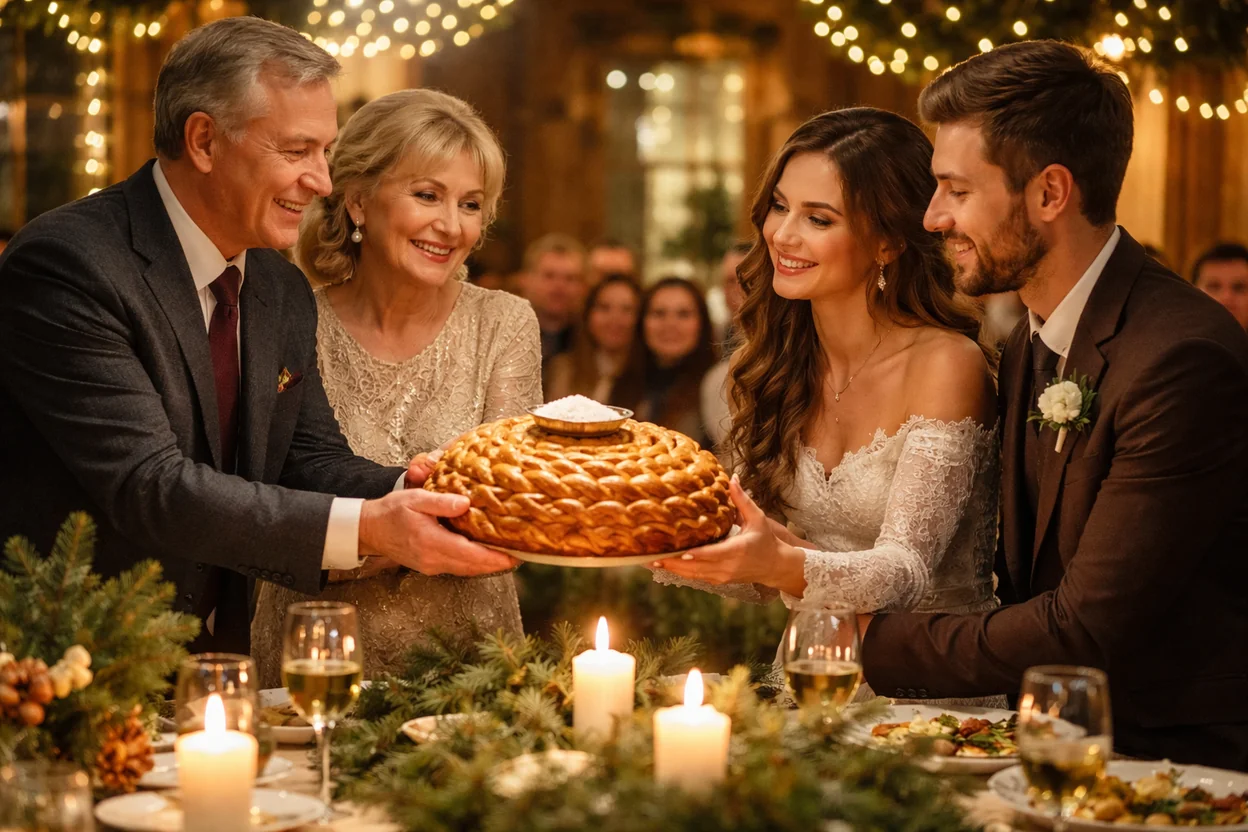
The parental blessing. Before or after the civil registration, the parents greet the couple with icons and words of advice in religious families, or simply with bread and salt at the reception entrance in secular ones. For a foreign groom, this is the moment her family decides who you are. Learn a short thank-you sentence in Russian; the effort outweighs the pronunciation.
The karavai. The round decorated wedding loaf symbolizes prosperity and the new household. The playful modern ritual — each spouse takes a bite without hands, and whoever tears the bigger piece “rules the family” — always gets a laugh and photographs beautifully with candlelight behind it.
“Gor’ko!” Guests shout “Bitter!” and the couple kisses to sweeten the drink, usually while the crowd counts. Expect it all evening. Younger couples sometimes agree with the host to contain it; do not try to abolish it, because it is the one ritual every guest expects to perform.
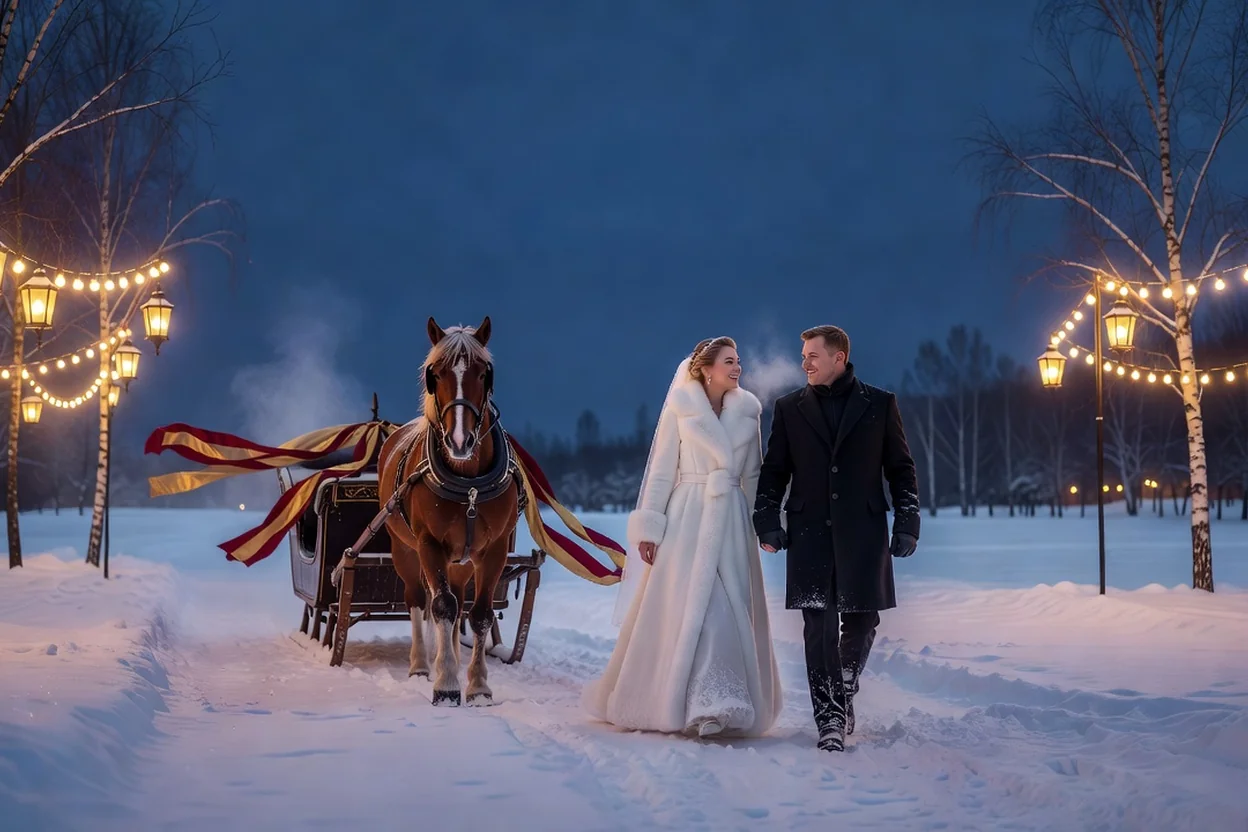
The shuba. The fur coat, cape, or fur-trimmed shawl over the dress is winter’s signature look. Today it is as much practical as symbolic — a faux-fur cape or wool cloak keeps the bride outside long enough for real photographs. Budget-conscious couples rent one for the day.
The troika ride. A three-horse sleigh through a snowy park or estate is the theatrical highlight of a winter photo session. More affordable variants — a decorated one-horse sleigh, a vintage car, a carriage — deliver most of the effect. Treat it as a photo prop with a 20-minute window, not a transport plan.
If the ritual vocabulary — tamada, vykup, svadebnyi karavai — is new to you, the glossary of 35 essential Russian marriage terms will let you follow the day instead of guessing.
Building the day around six hours of daylight
This is the section that decides whether your winter wedding feels effortless or frantic. The core numbers:
| Month | Moscow daylight | Saint Petersburg daylight | Typical average temperature |
|---|---|---|---|
| November | 8–9 h, falling to ~7 h | 7–8 h, falling to ~6 h | Moscow −1 to −3°C; Petersburg 0 to +2°C |
| December | ~7 h early month, ~6 h at solstice | ~6 h early month, ~5 h at solstice | Moscow ~−6°C; Petersburg −4 to −5°C |
| January | ~7 h rising toward 8 h | ~6 h rising toward 7 h | Moscow −7 to −9°C; Petersburg −5 to −7°C |
| February | 8–10 h | 7–9 h | Moscow −6 to −8°C; Petersburg −4 to −6°C |
Around mid-December, the sun sets near 15:55 in Moscow and 15:35–15:45 in Saint Petersburg, while the latest sunrises come around 09:00 and 09:50 respectively in late December. Civil twilight adds roughly 30–45 minutes of usable ambient light at each end — but heavy cloud and wet snow can eat that margin.
A Moscow winter timeline that works:
- Morning preparations at a hotel or venue near the ZAGS office — keep the radius small, winter traffic is slower.
- Civil registration at ZAGS around 11:00–12:00, when the light is already useful.
- Compact outdoor session 12:30–14:30: group portraits first (they take longer and tolerate low light less), couple portraits second, shuba and sleigh shots last while everyone still has feeling in their fingers.
- Indoor backup identified in advance — a hotel lobby, museum hall, or covered courtyard — in case wind or freezing rain turns.
- Blue hour, 15:30–16:15, used deliberately: illuminated architecture, candles, flash portraits. Night shots in snowfall are stunning; plan the lighting rather than hoping.
- Reception from 16:30, starting with the parental blessing and karavai while guests arrive from the cold.
Saint Petersburg runs the same plan roughly 30–45 minutes earlier, and the photographer’s cold protocol matters everywhere: spare batteries in an inside pocket (cold drains them fast), weather-sealed bodies, and short warm-up breaks to avoid lens fogging when moving between heated interiors and freezing air.
What a winter wedding costs in Moscow in 2026
Winter does not make a Russian wedding cheap, but it makes the same wedding cheaper than June. Realistic Moscow budgets for 2025–2026: ₽1–1.5 million for a modest 20–30 guest event, ₽2.5–3 million for a comfortable 50-person celebration, and ₽5–8 million or more for a premium production.
| Item | Typical price in rubles |
|---|---|
| Restaurant banquet, food only | ₽6,000–15,000 per guest |
| Alcohol | +₽1,000–3,000 per guest depending on the bar package |
| Photographer, 5 hours | ~₽35,000 |
| Photographer, 10–12 hours | ₽80,000–200,000 (premium: ₽200,000–300,000) |
| Wedding host (tamada or modern MC), 4 hours | ~₽20,000 basic; ₽60,000+ experienced |
| Host plus DJ package | ₽100,000–150,000 |
| Service charge | ~10%, reportedly creeping up in 2026 |
For a 50-person banquet, food alone lands around ₽300,000–750,000 before alcohol, service, venue rental, décor, and cake. Our dedicated breakdown of how much a wedding in Russia costs goes deeper on the line items.
Winter is where you win the negotiation. January, February, and weekday dates sit in the venues’ soft season, and typical concessions include waived venue rental, lower minimum spends, complimentary cake or welcome drinks, and reduced corkage. There is no standard discount percentage — instead, request the same written quotation for a summer Saturday and for your winter date and compare total minimum spends.
If you are the foreign partner paying in a Western currency, the ruble cuts both ways. At roughly ₽82–83 per US dollar in late 2026, a ₽2.5–3 million wedding is about $30,000–36,000 — and a weakening ruble makes it cheaper for you while local vendors, whose labor is ruble-denominated, reprice only slowly. Inflation (about 4.2% through 2025) erodes the advantage over a long engagement, so the safe play is: reserve the venue early, fix ruble prices in the contract, pay only the agreed deposit, and keep a 10–15% buffer for exchange-rate movement and last-minute additions.
The winter honeymoon: Baikal, Karelia, Krasnaya Polyana, Veliky Ustyug
The wedding ends at 3 a.m.; the honeymoon should feel like the country is rewarding you. Four destinations dominate the Russian winter:
| Destination | Best period | Indicative couple cost | Character |
|---|---|---|---|
| Lake Baikal ice | Mid-February – mid-March | $1,170–4,300 for 4–7 nights (flights extra) | Turquoise ice, ice roads, Olkhon Island — the once-in-a-lifetime option |
| Karelia | January – March | ₽100,000–250,000 for 3–4 nights (transport extra) | Glass cabins, husky rides, saunas, Ruskeala park — private and quiet |
| Krasnaya Polyana (Sochi) | December – March | ₽150,000–400,000 for 4–5 nights | Ski resorts, spas, restaurants — comfortable and easy to reach |
| Veliky Ustyug | Late December – early January | ₽60,000–150,000 for 2–3 nights | The Ded Moroz residence — festive and whimsical, more fairy tale than romance |
Baikal is the clear winner for spectacle: published 2027 tours already list departures through February and March, from a 4-day transparent-ice program at about $586 per person to 6–7-day itineraries between $806 and $1,713 per person. Fly to Irkutsk, base in Listvyanka or Olkhon, and book a private or small-group vehicle — shared group tours mean long drives and basic lodging.
Karelia suits couples who want silence: heated panoramic cabins near Petrozavodsk, Sortavala, or the Ladoga Skerries run roughly ₽25,000–60,000 per night, with husky sledding and Ruskeala’s frozen canyon nearby. Confirm directly with the property what is actually heated — “glass igloo” listings sometimes describe unheated domes.
Krasnaya Polyana is the pragmatic luxury pick: fly to Sochi, transfer 40–60 minutes to Rosa Khutor or Gazprom, and split the days between slopes and spa. Avoid the New Year minimum-stay pricing if you can; late January and February give better snow and lower rates.
One combined itinerary worth considering if you have ten days: three nights in Karelia for the cabin-and-sauna intimacy, then four nights in Krasnaya Polyana for the resort comfort. It adds domestic flights, so it is less restful than one region — but it compresses the two opposite poles of the Russian winter into a single trip.
What to wear and what to pack
Winter forgives nothing in clothing and rewards everything. The working rules:
- The bride: dress plus a real shuba or faux-fur cape, thermal tights under the skirt, and winter boots for transit with heels carried in a bag. Gloves that photograph (leather or fur-trimmed) live in the maid of honor’s pocket.
- The groom: wool overcoat over the suit, never a ski jacket in photographs; thermal base layers; leather gloves.
- The guests: tell them explicitly. A line in the invitation — “the ceremony includes 30 minutes outdoors” — prevents the eternal Russian dilemma of fashion versus frostbite. Provide a heated room and hot drinks on arrival.
- Everyone: textured soles. Icy pavement in December has humbled more wedding parties than any other single detail.
The mistakes that ruin winter weddings
Every item on this list is avoidable, and most come from planning a winter wedding with a summer brain:
- Scheduling outdoor portraits after 15:00 in December and hoping for “golden light” — the light is gone; you get blue hour or nothing
- No indoor backup location booked in advance, so freezing rain sends twelve people into a hotel lobby uninvited
- Long gaps between venues — winter transfers take longer than the map suggests, and guests standing on an icy sidewalk sour fast
- Underestimating battery drain and lens fogging; a photographer without cold protocol loses the last hour of usable light
- Choosing a venue for its terrace and ignoring its winter reality: cloakroom capacity, wet-boot traffic, and whether the dance floor sits next to a permanently opening exterior door
- Skipping the written winter quote comparison and paying summer-season minimums in February
- Promising the couple a troika ride without checking it exists at that venue on that date — book it as a named vendor with a weather clause
- Forgetting the guest experience: no place to put coats, no hot drinks on arrival, no warning about outdoor segments in the invitation
A winter wedding is a decision, not a fallback
The couples who get winter weddings right share one trait: they chose the season before they chose the venue. That single inversion — winter first, everything else after — changes the entire planning posture. You stop fighting the short day and start staging it: morning ZAGS, midday portraits in the snow, blue-hour architecture, candle-lit reception, “Gor’ko!” at midnight while snow falls past the windows.
And after the last toast, the country itself becomes the wedding gift. Two days later you can be standing on a meter of transparent ice over the oldest lake on Earth, or in a sauna in Karelia while snow settles on the pines outside. Russia in winter does not do halfway — which is, when you think about it, exactly the right note to begin a marriage on.
Frequently Asked Questions
Is winter a good season for a wedding in Russia?
Yes, and it is underrated. Winter was historically a practical wedding season in Russia — after the harvest, families had time and stores of food. Today the practical advantages are venue availability and discounts: January, February, and weekday dates are the easiest to negotiate, because demand is far below the May–September peak. The trade-off is short daylight (about six hours in Moscow in December) and cold, both of which are manageable with the right schedule.
Which Russian wedding traditions matter most in winter?
The parental blessing with bread and salt, the karavai wedding loaf, and the 'Gor'ko!' kiss chant work in any season and anchor the reception. Winter adds three visual traditions: the shuba (fur or faux-fur coat over the dress), a troika or sleigh ride for photographs, and snow-covered city backdrops that need almost no decoration. None of these are religious requirements, so secular couples can keep them as family heritage.
How much does a winter wedding in Moscow cost in 2026?
For 20–30 guests at a modest venue, plan on ₽1–1.5 million; a comfortable 50-person celebration runs ₽2.5–3 million; premium events exceed ₽5–8 million. Restaurant banquets average ₽6,000–15,000 per guest for food plus ₽1,000–3,000 for alcohol. Winter weekday dates can bring meaningful discounts on venue rental and minimum spend, so always request the same written quote for a summer Saturday and your winter date.
When should we schedule outdoor photos in a Russian winter wedding?
Between 11:00 and 14:00 in December and January, when the sun is highest. In Moscow the sun sets around 15:55 in mid-December and rises around 09:00; in Saint Petersburg it is roughly 20 minutes earlier on both ends. Finish essential group portraits by about 15:00 and couple portraits by 15:30 in Moscow (15:00 in Petersburg), then use the blue hour deliberately for illuminated architecture and candle-lit interiors.
Where do Russian couples go for a winter honeymoon?
The four classics are Lake Baikal in February–March (turquoise ice, organized tours from about $1,170–4,300 per couple), Karelia for glass cabins and husky rides (₽100,000–250,000 for 3–4 nights), Krasnaya Polyana near Sochi for ski resorts and spas (₽150,000–400,000 for 4–5 nights), and Veliky Ustyug for the Ded Moroz residence in December. Baikal is the most spectacular; Krasnaya Polyana is the most comfortable.