 EN
EN ES
ES FR
FR RU
RU
Russia registered 880,000 marriages in 2024, according to Rosstat, and 644,500 divorces in the same year. That works out to roughly 73 divorces for every 100 marriages. Russians are also marrying later than they used to, with reporting based on Rosstat figures placing the average groom near 34.7 and the average bride near 32.6.
On international marriages, the number most people come looking for does not exist. Rosstat publishes national totals for marriages and divorces, but no country-wide breakdown by spouse nationality. What follows is what the official data actually says, and precisely where the reliable numbers stop.
The headline number: 880,000 marriages in 2024
The annual marriage count is the one figure in Russian family statistics that is genuinely well documented, published every year by Rosstat, and consistent across sources.
Its trajectory over the past fifteen years runs steeply downward. Russia registered roughly 1.2 to 1.3 million marriages a year in the early 2010s, peaking around 2011. By 2023 the annual figure had fallen to about 946,000. In 2024 it dropped again to 880,000, a decline of roughly seven percent year on year. Rosstat partial-year data made the direction visible before the annual total landed: marriages in the first nine months of 2024 came to 689,761, against 724,271 across the same nine months of 2023.
One detail from that year captures the scale of the shift. September has traditionally been a heavy month for Russian weddings. September 2024 marriages fell to an eighteen-year low.
Then the line moved the other way. Rosstat reported that February 2025 marriages rose 11.9 percent compared with February 2024, and that January-February 2025 was up 15.0 percent year on year. A real rebound, measured against a weak base, over two months. Worth noting, not worth over-reading.
- Early 2010s: roughly 1.2 to 1.3 million marriages a year, peaking around 2011
- 2022: approximately 1.05 million, inflated by a documented surge following mobilization
- 2023: about 946,000
- 2024: 880,000, the lowest figure outside the pandemic years
- Early 2025: January-February up 15.0 percent year on year
The 2022 number carries a caveat that usually gets dropped in translation. That year total was pushed up by a rush of registrations connected to mobilization, which makes it a poor baseline for measuring anything at all. Comparing 2024 against 2022 exaggerates the decline. Comparing it against 2023 is the defensible reading.
Marriage and divorce, read together
Divorce is where Russian family statistics get quoted most often, and misquoted nearly as often.
The 2024 pairing is 880,000 marriages against 644,500 divorces. Divide one by the other and you get roughly 73 divorces per 100 marriages. Much press coverage rounds this to “eight out of ten Russian marriages end in divorce,” and one VCIOM-linked report described Russia as third in the world by number of divorces.
That eight-in-ten framing is shorthand, not arithmetic. The divorces recorded in 2024 mostly ended marriages contracted years or decades earlier, not the marriages registered in 2024. Comparing two different cohorts inside the same calendar year produces a ratio that is easy to repeat and hard to interpret. It says something real about the volume of marital dissolution in Russian society. It does not give you the probability that a couple marrying today will divorce.
The survey work on causes is more directly useful than the ratio. A 2024 VCIOM survey asked Russians why marriages break down. Financial hardship and the inability to support a family led at 38 percent, infidelity followed at 18 percent, and a lack of mutual understanding at 14 percent. Money came first by a wide margin, which sits awkwardly beside the cultural-difference explanations that dominate discussion of mixed marriages. Anyone weighing those figures should also look at which spouse actually files for divorce in Russia, because the initiation pattern is as informative as the totals.
There is also the familiar catch-all answer that appears constantly in surveys and in ZAGS paperwork: ne soshlis kharakterami, we did not get along. Socially convenient, analytically empty.
For scale, Rosstat-compiled figures put Russia’s divorce rate at 4.7 per 1,000 population in 2023. That is the metric to use when comparing Russia against other countries, because unlike the divorces-per-marriage ratio it does not depend on how many people happened to marry that year. It is also the figure least often quoted, precisely because it sounds less dramatic than eight in ten.
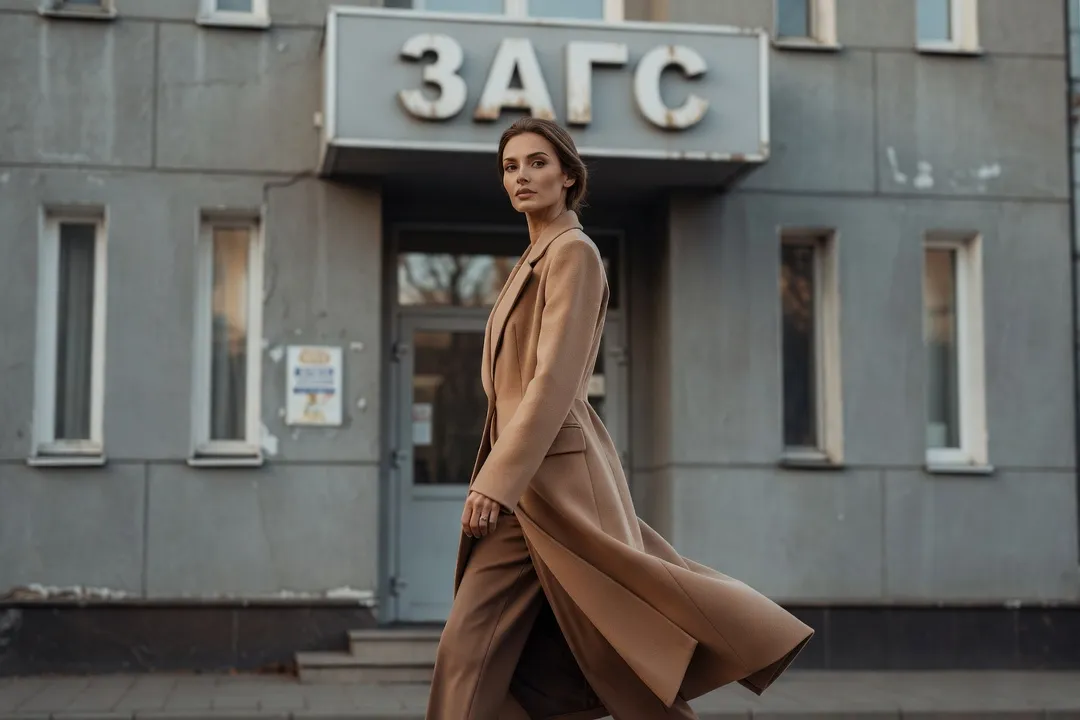
Age at marriage: later, and the averages mislead
Russians marry later than their parents did. On that point the data is unambiguous.
The specific figures require care. Reporting drawn from Rosstat material places the average groom at 34.7 and the average bride at 32.6. Those are averages across all marriages, and they include remarriages, which are numerous in a country registering 644,500 divorces a year. Second and third marriages happen at older ages and pull the average upward. Rosstat demographic yearbooks contain proper age-at-first-marriage tables, and those figures come out lower.
The practical consequence matters for anyone reasoning about Russian women in their late twenties or early thirties. An unmarried Russian woman of 30 is not a demographic anomaly. She sits close to the middle of the distribution. Treating 30 as unusually late reflects a stereotype the current data does not support, and it quietly distorts the traits that shape intercultural relationships.
| Indicator | Figure | Source basis |
|---|---|---|
| Marriages registered, 2024 | 880,000 | Rosstat |
| Marriages registered, 2023 | ~946,000 | Rosstat |
| Marriages registered, 2022 | ~1.05 million | Rosstat, mobilization-inflated |
| Divorces, 2024 | 644,500 | Rosstat |
| Divorces per 100 marriages, 2024 | ~73 | Calculated from the two Rosstat totals |
| Divorce rate per 1,000 population, 2023 | 4.7 | Rosstat-compiled |
| Average age, groom (all marriages) | ~34.7 | Rosstat-based reporting |
| Average age, bride (all marriages) | ~32.6 | Rosstat-based reporting |
| Marriages with foreign citizens, Moscow, since 2020 | 6,000+ | Moscow civil registry office |
| Share of Moscow marriages involving a foreigner | ~15% | Moscow civil registry office |
International marriages: the number Russia does not publish
Here is the gap that matters most for readers of this site, and it deserves stating plainly rather than papering over.
Rosstat does not publish a national breakdown of marriages by spouse nationality. There is no official annual figure for how many Russian citizens marry foreigners, no official ranking of which nationalities they marry, and no official time series showing whether that number is rising or falling. Any article handing you a confident national figure for Russian-foreigner marriages is either citing a regional source as though it were national, or has produced the number some other way.
What does exist is regional registry-office reporting, and the Moscow material is the most substantial. The capital civil registry office reported that more than 6,000 marriages involving foreign citizens had been registered in Moscow since the beginning of 2020, and that such unions made up roughly 15 percent of the capital total. Foreign grooms came from about 100 countries, foreign brides from about 60.
The nationality breakdown is more specific than most readers expect. Among foreign grooms marrying Russian women in Moscow, the most frequent nationalities were Turkey, Nigeria, Vietnam, the United States, England, Italy, Israel and Germany. For one reported Moscow period the counts ran: 81 Turkish men, 63 Nigerian, 54 Vietnamese, 47 American, 42 English, 41 Italian, 40 Israeli and 32 German.
- Foreign grooms marrying Russian women (Moscow): Turkey, Nigeria, Vietnam, United States, England, Italy, Israel, Germany
- Foreign brides marrying Russian men (Moscow): Greece, Vietnam, Nigeria, Latvia, Estonia, Germany, Cuba
Two things stand out. The Western European and North American nationalities that dominate the English-language conversation about Russian marriage are present, but they do not lead the list. Turkey does. And the absolute numbers are small: 47 American grooms across a reported Moscow period, in a city registering tens of thousands of marriages a year.
The second point is geographic. Moscow is the least representative city in Russia for this particular question. It concentrates the diplomatic corps, the foreign business community, the international student population and the highest-income domestic migration. A 15 percent foreign-spouse share in Moscow tells you very little about Novosibirsk or Voronezh, which is one reason living in Russian regions rather than the metropolis is worth reading before generalizing from capital-city data.
Why the international figure is missing
The absence is not a conspiracy, and understanding its cause helps you judge which other claims to trust.
Rosstat marriage statistics are built from ZAGS registration records aggregated for demographic purposes. The questions that system was designed to answer concern fertility, household formation and population change. Spouse citizenship appears on the registration document, but it is not among the variables Rosstat routinely publishes in its national releases.
Regional registry offices sometimes publish it themselves, usually as a press item rather than a statistical release. That is exactly where the Moscow figures come from, and it explains why the data is patchy, unstandardized between regions, published irregularly, and impossible to aggregate into a national series.

A definitional problem would complicate the number even if it were published. A marriage between a Russian citizen and a foreigner registered in Turkey or the United States never enters Russian ZAGS statistics. Given how many such marriages are registered in the foreign spouse country instead, a Russia-only count would undercount the phenomenon substantially, by a margin nobody can quantify.
What changed after 2022
Two forces pulled in opposite directions, and separating them is harder than most commentary admits.
Marriage registrations spiked in 2022 around mobilization, a surge with specific legal and practical drivers. Registrations then fell in 2023 and again in 2024, reaching the lowest level outside the pandemic years.
At the same time a large number of Russians left the country, weighted heavily toward younger men. Emigration on that scale changes who is physically present to marry and alters the sex composition of the working-age population. A falling marriage count in a population where part of the marrying-age cohort has departed is not the same signal as a falling count in a stable one.
For international marriages specifically, sanctions, flight-route disruption and visa friction made ordinary cross-border courtship materially harder from 2022 onward. Whether that reduced the number of Russian-foreigner marriages, displaced them to registration abroad, or both at once, cannot be determined from published Russian data. The measurement is simply absent. The same practical friction surfaces in the guide to Russian brides over 40, where travel logistics now weigh far more heavily than they did before.
Reading Russian marriage statistics without getting fooled
A few habits separate a defensible reading from a careless one.
Check whether a figure is national or regional. This is the single most common failure in English-language writing about Russian marriage. Moscow registry data is real and useful, and it is not Russia.
Check the year, and check what that year contained. Any comparison anchored on 2022 inherits the mobilization surge and will overstate whatever decline it describes.
Separate measurements from surveys. The 880,000 marriage count is an administrative total. The VCIOM finding that 38 percent name financial hardship as the leading cause of divorce is a survey result about stated perceptions. Both are legitimate, they are not the same kind of fact, and they should not be quoted with equal confidence.
Be suspicious of round numbers in this field. “Eight out of ten marriages end in divorce” is a rounded restatement of a 73-per-100 ratio between two unrelated cohorts. “Ten million more women than men” is a real Rosstat-derived figure almost always deployed without the age structure that gives it meaning.
And when a national figure for international marriages turns up without a source, treat it as unsourced, because Rosstat does not publish one. Whoever has it either built it themselves or took a regional figure and quietly promoted it. Understanding who benefits from a given number often clarifies why it circulates in the first place.
The reliable core is smaller than people want it to be: 880,000 marriages in 2024, 644,500 divorces, a marrying age above 32 for women and near 35 for men, and a Moscow foreign-spouse share around 15 percent. Everything past that is inference, and the honest move is to label it as such.
Frequently Asked Questions
How many marriages are registered in Russia each year?
Rosstat recorded 880,000 marriages in 2024, down from about 946,000 in 2023 and roughly 1.05 million in 2022. Early 2025 showed a partial rebound, with February 2025 marriages up 11.9 percent year on year, but the decade-long direction remains downward from the 1.2 to 1.3 million marriages Russia registered in the early 2010s.
At what age do Russians typically marry?
Russians marry later than they did a generation ago. Reporting based on Rosstat data places the average groom around 34.7 and the average bride around 32.6, though these figures cover all marriages rather than first marriages specifically. Rosstat publishes age-at-first-marriage tables in its demographic yearbooks, and those numbers are lower, because remarriages pull the all-marriage average upward.
How many Russian women marry foreigners each year?
There is no national answer. Rosstat publishes total marriages and divorces but does not release a country-wide breakdown of marriages to foreign citizens. The only substantial public figures come from regional registry offices, above all Moscow, which reported more than 6,000 marriages with foreign citizens registered since the start of 2020, roughly 15 percent of the capital's total.
Which nationalities most often marry Russian women?
According to Moscow's civil registry office, the most frequent nationalities among foreign grooms marrying Russian women were Turkey, Nigeria, Vietnam, the United States, England, Italy, Israel and Germany. For one reported Moscow period the counts were 81 Turkish men, 63 Nigerian, 54 Vietnamese, 47 American, 42 English, 41 Italian, 40 Israeli and 32 German. These are Moscow figures only, not national ones.
Is the number of international marriages in Russia rising or falling?
Nobody publishes the series needed to answer that. Total marriages fell in 2023 and 2024, and the events of 2022 changed both travel and migration patterns considerably. Without a national time series on marriages to foreign citizens, any confident claim about the trend in international marriages specifically is an extrapolation rather than a measurement.