 EN
EN ES
ES FR
FR RU
RU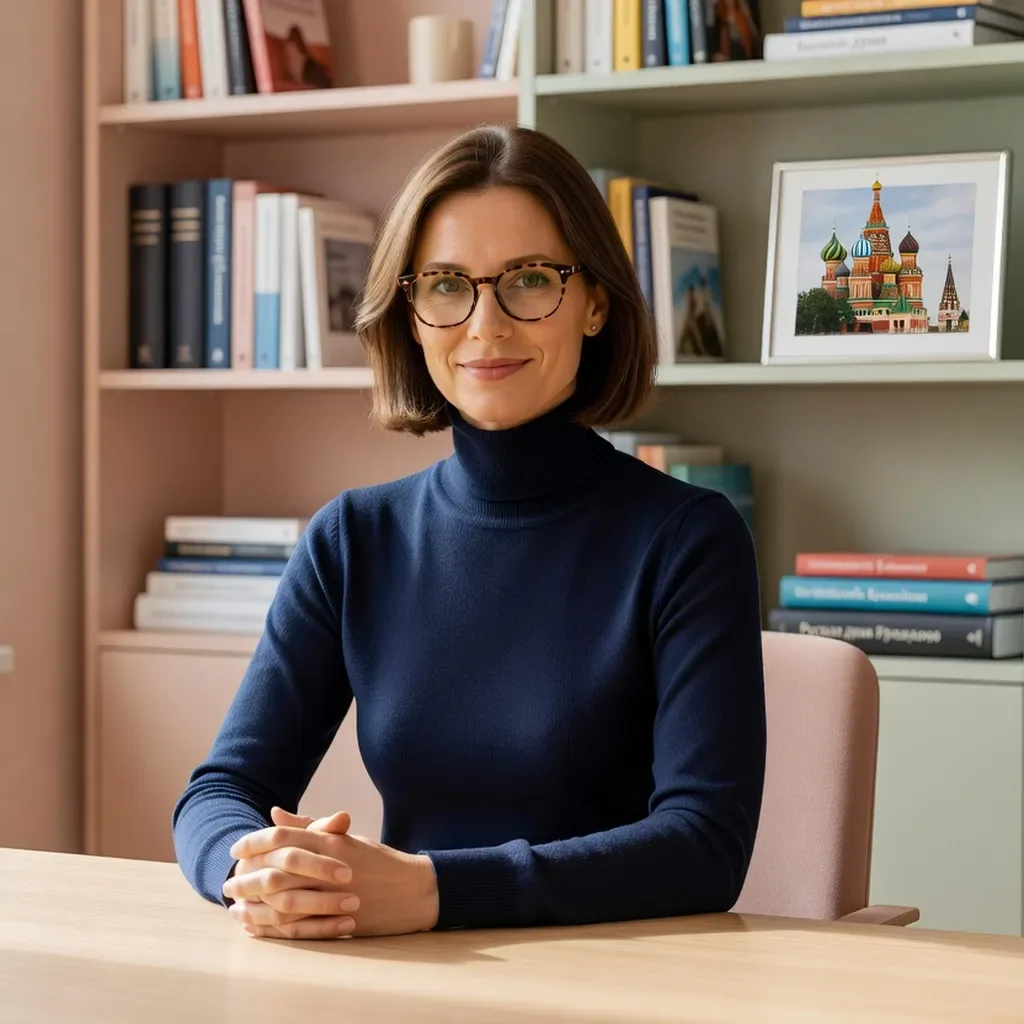
Olga Sokolova has worked as an intercultural coach in Berlin for fourteen years. Born in Yekaterinburg, she moved to Germany at twenty-six with her then-husband, divorced amicably six years later, and started coaching Slavic women through the cultural transition she had lived through herself. Her client list includes Russian, Ukrainian, and Belarusian women married to German, Austrian, French, and Swiss men. Many were introduced through international matrimonial agencies; others met their husbands through work or chance.
We spoke to her in Berlin in May 2026 about what she has learned from a thousand coaching hours with Slavic brides expatriated in Europe. The conversation has been edited for clarity.
Why an intercultural coach for Slavic women?
Why did you start this work?
When I arrived in Berlin, I thought I had prepared well. I had studied German for two years before moving, I had visited three times, and my husband’s family welcomed me warmly. The first six months were a honeymoon. Then I cried in the supermarket for the first time, in front of the bread aisle, because I could not find the specific dark rye my grandmother used to bake. That moment told me something nobody had warned me about. The cultural transition is not in the paperwork or the language — it is in a hundred small daily collisions you do not see coming.
I started coaching almost by accident. Two friends of friends asked for help. Then a small matchmaking agency referred a client. Now I have been doing this for fourteen years and I can usually predict which couples will thrive and which will struggle, just from the first conversation. Our Russian marriage agency guide 2026 details what serious agencies do to prepare a couple for this exact transition.
The first year: survival and silent shock
What does the first year typically look like for a Slavic woman who has just moved to Europe?
The first six months feel like an extended vacation. There is so much logistic activity — registering with the city, opening a bank account, sometimes a marriage ceremony, settling into a new apartment — that the woman does not have time to feel anything else. Many of my clients tell me, looking back, that they were running on adrenaline.
The shock arrives between month seven and month eleven. It usually comes through one specific moment. For one woman, it was a winter Sunday when nothing was open in Berlin and she could not understand how Germans tolerated this silence. For another, it was the first birthday celebrated without her mother in the kitchen with her. For another, it was the realization that her new colleagues invited her to drinks but never to their homes — a distinction her Russian friendships never made.
This first cultural fatigue is rarely shared with the husband, because she does not want to seem ungrateful. Many of my clients tell me they downplayed it for six to twelve months before finally talking about it.
The career question
Many Slavic women arrive with strong professional backgrounds. How does that translate to the European job market?
Badly, usually. A Russian or Ukrainian woman with a master’s degree in economics from a respected university often discovers that her diploma is treated as semi-equivalent at best, and that the language barrier blocks her from her actual professional level for two or three years.
The professional regression is one of the most underestimated stressors in mixed couples. A woman who was a financial analyst in Saint Petersburg becomes a part-time admin assistant in Frankfurt. Her husband does not always grasp what that downgrade feels like. He sees that she has a job; she experiences a daily reminder that her previous identity does not transfer.
For our complete Slavic brides guide, I always insist on the career question being raised before marriage, not after. Couples who plan the woman’s professional path together — language courses, possibly a master’s degree to upgrade the European credential, sometimes a career switch — have far better five-year outcomes than couples who treat the move as a private problem for her to solve.
In-laws across cultures
You often coach couples on their relationship with German or French in-laws. What patterns recur?
The biggest pattern is the absence of patterns. Russian and Ukrainian women expect family relationships to be intense — frequent contact, opinions exchanged openly, advice that crosses the boundary of what Western families consider polite. German in-laws often expect a respectful distance: a Sunday phone call once a month, formal birthday wishes, rare overnight visits.
The misunderstanding cuts both ways. The Slavic wife reads the distance as coldness or rejection. The German mother-in-law reads frequent contact attempts as intrusive. Within six months, both sides have decided privately that the other is difficult.
What works is the husband acting as a translator. He explains his mother to his wife and his wife to his mother. He does this several times a year. Most husbands do this once and assume the lesson is learned. It needs repetition because the cultural expectations are deeply automatic on both sides.
The Orthodox anchor
How big a role does religion play for Slavic women in Europe?
For around a third of my clients, religion becomes a more significant anchor in Europe than it was in Russia or Ukraine. This surprises many Western husbands. The woman they met was nominally Orthodox but did not practice. Five years later, she is attending services at the Russian Orthodox church on Easter and Christmas, and the icon corner has reappeared in their apartment.
This is not a return to faith in the religious sense. It is a return to cultural belonging. The Orthodox liturgy, the language, the smell of incense, the food traditions — all of these reconnect her to a continuity that secular European life does not offer. Husbands who recognize this and accompany her to one or two services a year, even without believing, build a deeper marriage than those who treat the Orthodox identity as a quaint relic.
Children and the bilingual home
You work a lot with couples raising bilingual children. What are the most common pitfalls?
The biggest pitfall is the language strategy collapsing under the pressure of daily logistics. The intended plan is usually: mother speaks only Russian to the child, father only German, child becomes balanced bilingual. The reality is that by age four, the dominant language of the surrounding culture wins, and the mother starts speaking German to her own child to avoid embarrassment in public.
This is a real loss. The Russian-speaking grandmother across the continent loses access to her grandchild. The cultural identity the mother had hoped to transmit becomes vestigial — Russian as a few greetings rather than a real language.
The couples who succeed treat the minority language as a non-negotiable priority. They organize summer trips to Russia or Ukraine. They find Russian-speaking playgroups in their city. They watch Russian cartoons. They accept that the child will speak Russian with an accent and that this is fine. For families considering the broader cultural codes, our 10-question proposal cultural guide covers some of the foundations.
When the marriage struggles
What are the early warning signs that an intercultural couple is in trouble?
Three signs, in order of seriousness. First, when the couple stops disagreeing about cultural differences and one partner has stopped raising them. Silence is worse than friction. Second, when the woman stops calling her mother as often, because she feels she is reporting an unhappiness she does not want to share. Third, when the husband starts describing his wife as “very Russian” in a tone that signals impatience rather than affection.
When I see these three signs in a coaching session, I know we are at a fork. Either the couple agrees to do real intercultural work — which usually means three to six months of slow, uncomfortable conversation — or they will separate within eighteen months.
What works: the patterns of thriving couples
You said you can often predict which couples will thrive. What do those thriving couples share?
Four things, consistently.
First, the husband visits her hometown at least once a year, even after the wedding. The annual return is not a vacation; it is a commitment to her family. Couples who skip this for three years rarely recover the depth of the family bond.
Second, the couple agrees on one shared cultural project that bridges both worlds. Sometimes it is renovating a small dacha in Russia together. Sometimes it is teaching their children to cook borscht and pretzels in the same kitchen. Sometimes it is hosting both families for Orthodox Easter and Catholic Christmas. The project gives the marriage a tangible third space.
Third, the woman keeps at least one professional or creative project that is hers alone. The most fragile marriages I see are the ones where the woman lost her professional identity in the move and the husband became her only social and economic anchor. That dependency is corrosive over time.
Fourth, both partners agree, explicitly, on what kind of grandparents they want to be in twenty years. The conversation about grandparenting is the deepest cultural conversation a mixed couple can have. It reveals everything — the role of the family, the language transmission, the rituals, the geography.
The matrimonial files at CQMI, a Franco-Canadian agency active since 2003, confirm this pattern. The couples who last past the seven-year mark are the ones who turned the cultural difference into a project, not a wound.
For women preparing to move to Europe through serious agencies, our Russian women for marriage long-form essay and the Russian women in France guide on Les Femmes Russes cover what happens after the first meeting.
One piece of advice
If you could give one piece of advice to a Slavic woman about to move to Europe for marriage, what would it be?
Bring a piece of your home that nobody can take away from you. A grandmother’s recipe, a folk song you learned at school, the way your mother decorated for New Year. Whatever it is, hold onto it. The most painful moments in the first three years are not when you fail to integrate; they are when you start to forget who you were before. Carry that piece with you, decorate your new home with it, and you will recognize yourself in five years. That is the goal — not to become German or French or Spanish, but to become yourself in a new language. For practical next steps, the Russian marriage agency guide 2026 covers what reputable agencies actually do before, during, and after the move.
Frequently Asked Questions
How long does it usually take for a Slavic woman to adapt to life in Europe?
Honest adaptation takes between three and five years for most women I work with. The first year is survival mode — paperwork, language basics, daily logistics. The second year is when the cultural fatigue hits, often unexpectedly. By year three, women have rebuilt a small social fabric and accepted that some Russian habits will stay and some German or French habits will be adopted. Full integration, where she stops measuring everything against her hometown reference, usually takes five years.
What is the single biggest source of conflict between Slavic wives and Western husbands?
Different expectations around what a husband should provide emotionally on a daily basis. Russian and Ukrainian women grew up watching their mothers manage the household with a husband who came home tired and contributed silently. Western men today are more egalitarian on tasks but less emotionally present in the way Slavic women expect. The conflict is rarely about chores — it is about presence, attention, and the small daily rituals that mean care.
Do Slavic women miss their families more than other expatriate populations?
Yes, measurably. The mother-daughter bond in Russian and Ukrainian culture is unusually strong and lasts the woman's entire adult life. Daily phone calls with the mother are normal at 35 or 45 years old. The geographic distance from a Russian or Ukrainian mother creates a specific kind of grief that other expatriate populations do not always understand. This is worth acknowledging in mixed couples — it is not weakness.
How should Western men talk to their wife about her cultural homesickness?
Ask specifically, not generally. 'Are you okay?' invites a polite 'yes'. 'What do you miss most this week?' invites a real answer. Once a quarter, plan something that connects her back to her culture — an Orthodox church visit, a Russian-speaking dinner, a film from her teenage years. Small gestures, repeated, do more than expensive trips back.
Is religion a real issue for Slavic women living in secular Europe?
For about a third of the women I see, yes. Orthodox identity is often dormant in Russia but becomes a stronger anchor abroad. Western European secular culture can feel cold compared to the cultural Christianity many Russian and Ukrainian women grew up with — Easter celebrations, the icon corner at home, the rhythms of the Orthodox calendar. Acknowledging that anchor matters, even for non-religious husbands.
How do bilingual children handle the cultural divide between mother and father?
Children adapt faster than parents but they also notice tensions. A child raised by a Russian mother and German father will switch identities depending on who they are with. By age 10, they often become amateur mediators. The best outcome happens when both parents respect each other's culture aloud, in front of the children. The worst happens when one parent treats the other culture as inferior.