 EN
EN ES
ES FR
FR RU
RUInternational Marriage Russia/Ukraine 2026 : Lawyer Interview
International marriages between French citizens and Russian or Ukrainian spouses raise legal questions that domestic marriage simply does not. Which country’s law applies to the matrimonial regime? What happens to a Saint-Petersburg apartment owned before the wedding? How does French civil status reconcile with a Ukrainian birth certificate apostilled in Kyiv? These questions are not theoretical — they decide the financial, parental and inheritance future of thousands of Franco-Slavic couples. For more, see our Russian vs Ukrainian women.
To clarify the legal landscape in 2026, we spoke at length with Maitre Stephanie Kovalenko, a family law attorney based in Lyon who has spent twelve years untangling cross-border divorces, prenups, custody battles and successions involving Russian and Ukrainian spouses. Her perspective is both technical and deeply human — she has seen what works, what fails, and what couples wish they had known before signing the marriage register. For more, see our K-1 visa guide for Russian fiancees.

Maitre Stephanie Kovalenko
12 years specialized in international family law (Russia/Ukraine). Franco-Russian and Franco-Ukrainian family law cases.
The Legal Foundation: Which Country’s Law Governs the Marriage?
Thomas Beaulieu : Maitre Kovalenko, when a French citizen marries a Russian or Ukrainian spouse, the most fundamental question seems to be — which legal system governs the marriage? Most couples assume "French law because we marry in France", but it's more complicated than that, isn't it?
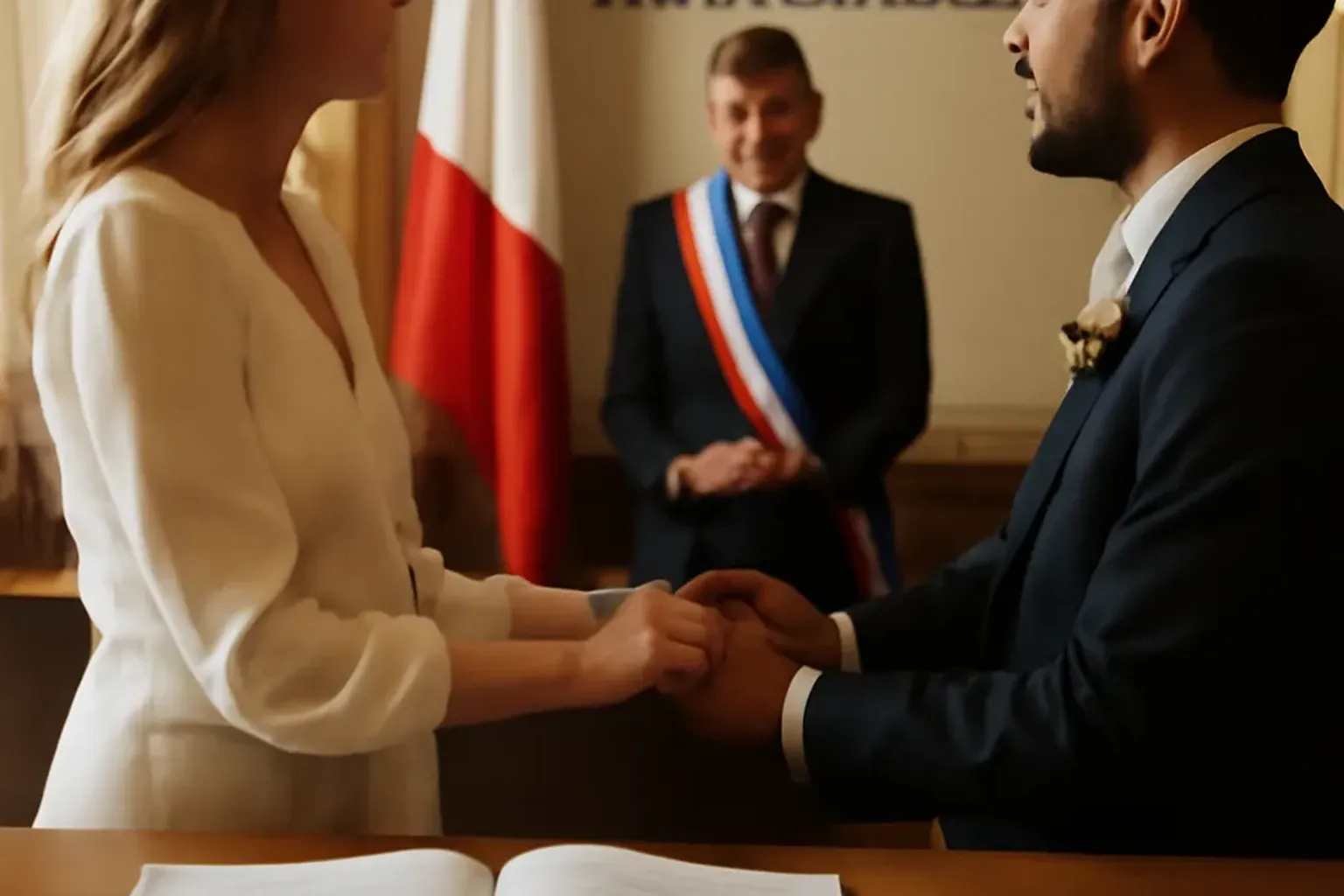
Stephanie : Yes, and the confusion is understandable because the answer depends on what aspect of the marriage we're talking about. We need to distinguish three layers. First, the **form of the celebration**: this is governed by the law of the place where the marriage is performed. So if you marry at the town hall in Lyon, French law dictates the procedure, the publication of banns, the role of the mayor, the witnesses — and it's worth noting this civil ceremony is legally separate from any religious blessing; couples who also want an [Orthodox wedding ceremony](/blog/orthodox-wedding-mixed-couple-guide-2026/) typically hold that as an additional, non-binding rite. Second, the **personal effects** of the marriage — fidelity, mutual support, contribution to household expenses — these follow the law of the spouses' common nationality, or, lacking that, their habitual residence. Third, and this is where it gets technical, the **matrimonial property regime**, which determines who owns what.Since January 29, 2019, EU Regulation 2016/1103 on matrimonial property regimes applies. Couples married after that date can choose their applicable law:
- The law of one spouse’s nationality;
- The law of their habitual residence.
If they don’t choose, the law of their first common habitual residence after the marriage applies.
Let me give you a concrete example from a 2024 file. A French engineer in Lyon married a Ukrainian pharmacist who came to France on a long-stay visa. They married in Lyon, lived in Lyon for the first year, then moved together to Kyiv for two years before returning. The applicable law to their matrimonial regime was French law, because their first common habitual residence after marriage was in France. Even when they were living in Kyiv, French regime law continued to govern their property. That surprised both of them when we discussed it. Couples preparing for this kind of cross-border life often start with our step-by-step guide to find a Russian bride, which sets the practical context before the legal layer.
Pre-Marital Declarations and the “Regime Matrimonial”
Thomas Beaulieu : So a couple can already make life-changing legal commitments at the town hall counter without realizing it. What declarations do they sign and what do those mean?
Stephanie : When you marry in France without a prenup, you fall by default into the **community of acquisitions** regime — *communaute reduite aux acquets*. Everything earned, purchased or produced during the marriage becomes joint property, while what you owned before stays personal. This sounds simple but it creates real problems for international couples.Imagine my Ukrainian client Olena — name changed — who owned an apartment in Odessa before her 2022 marriage to a French civil servant. The apartment is hers personally. But during the marriage she rented it out for €600 a month. That rental income is community property under French law. When they divorced in 2024, her husband claimed half of three years of rent, even though the apartment had never set foot in France. The judge agreed with him — partially.
This is why I always insist that international couples consult a notaire before the marriage, not after. The 30-minute fee for a pre-marital consultation can save tens of thousands of euros and years of conflict. The notaire explains the four French regimes: separation of property, community of acquisitions, universal community, and participation in acquisitions. For an international couple, I almost always recommend separation of property with a participation clause, because it preserves each spouse’s autonomy and respects assets located abroad.
Prenuptial Agreement: When and Why for International Couples
Thomas Beaulieu : Some readers might think a prenup is unromantic, or that it's only for wealthy couples. What's your view?
Stephanie : A prenup is not unromantic — it is **clarity**. And clarity, in international family law, is love expressed through paperwork. The wealthy couple cliche is misleading: the people who suffer most from the absence of a prenup are middle-class couples whose assets are spread between two countries.I’ll be specific. A prenup is essential when:
Checklist: When a prenup is essential
- One spouse owns real estate in Russia or Ukraine before marriage and wants to keep it (and its rental income) strictly personal.
- One spouse co-owns a business with relatives back home (common in Ukraine).
- The couple plans to move to a different country during the marriage.
- One spouse has children from a previous marriage and wants to protect their inheritance rights.
- The age gap is significant, requiring complex succession planning.
In France, a prenup must be signed before a notaire before the wedding. The notaire reads the contract aloud, explains each clause, and registers it. Cost: between €350 and €600 depending on complexity. Once signed, the prenup is mentioned on your marriage certificate and binds both spouses for life — modifiable only after two years of marriage and with judicial approval if minor children are involved.
Russian and Ukrainian law also recognize marriage contracts (brachnyi dogovor), so a prenup signed in France can be registered in the spouse’s home country and have effect there too. I had one couple in 2023, French husband and Russian wife from Saint-Petersburg, who signed a prenup in Lyon then had it translated and registered with a notary in Saint-Petersburg. It cost them €1,200 in total. When the wife inherited an apartment in Russia in 2024, there was zero ambiguity about ownership. For a deeper look at how patrimony and inheritance planning work in practice, our interview with a notary on finances and patrimony for Franco-Russian couples walks through several real cases.
Key takeaway A French prenup is not just a French formality. Once signed before a notaire (€350-€600), it can also be translated and registered with a notary in Russia or Ukraine — closing the gap between the two legal systems before any dispute arises, rather than after.
For more, see our interview with psychologist Marina Volkova.
The Civil Marriage Ceremony in France: Documents from Russia/Ukraine
Thomas Beaulieu : Let's get practical. A French citizen wants to marry their Russian or Ukrainian fiancee in France. What documents are needed?
Stephanie : The list seems straightforward but execution is where things break. The foreign spouse needs:
- A valid passport — sounds obvious, but I’ve seen passports expiring within 6 months refused.
- A birth certificate dated less than 6 months issued by Russian or Ukrainian civil registry. It must be a povtornyi certificate in Russia (a re-issue), not the original from birth.
- A certificate of celibacy or non-impediment to marriage. In Ukraine, this is the dovidka pro simeinyi stan. In Russia, it’s a spravka ob otsutstvii brachnykh otnoshenii.
- A certificate of customary law (certificat de coutume) issued by the embassy or consulate, certifying that the spouse meets the requirements to marry under their own national law.
- All foreign documents must be apostilled under the 1961 Hague Convention and translated into French by a court-certified translator (traducteur assermente).
The apostille issue has gotten complicated since 2023. Ukraine continues to issue apostilles normally through its Ministry of Justice. For Russia, technically the apostille system still works through the Ministry of Foreign Affairs, but several French prefectures since 2023 have started requesting additional consular legalization out of caution. I’ve had files held up for three months on this technicality alone.
My practical advice: start gathering documents at least four months before the planned wedding date. The town hall publishes the banns for ten days minimum, which is often forgotten in the timeline.
| Document required | Issued by | Validity / key condition |
|---|---|---|
| Valid passport | Russian / Ukrainian authorities | Must not expire within 6 months of the wedding |
| Birth certificate | Civil registry (povtornyi re-issue in Russia) | Dated less than 6 months |
| Certificate of celibacy | Ukraine: dovidka pro simeinyi stan / Russia: spravka ob otsutstvii brachnykh otnoshenii | Valid only 6 months |
| Certificate of customary law | Embassy or consulate | Confirms eligibility to marry under home country law |
| Apostille + certified translation | Ministry of Justice (Ukraine) / Ministry of Foreign Affairs (Russia) + traducteur assermente | Original apostilled first, then translated — never the reverse |
Common Pitfalls: Translation, Apostille, Civil Status Discrepancies
Thomas Beaulieu : You mentioned files held up for months. What are the most common pitfalls you see?
Stephanie : Three big ones, in order of frequency.First, name discrepancies. Russian and Ukrainian names are transliterated differently depending on the alphabet of arrival — French uses one system, English another. A woman named Olha in Ukrainian Cyrillic might appear as Olga in her translated birth certificate, Olha on her passport, Olha-Olga on her visa. The town hall will refuse the file until all documents match.
Second, the certificate of celibacy expires. It’s valid only 6 months. If you obtain it in March and the wedding is in November, you need to redo it. I had a Lyon couple in 2023 lose their wedding date because the certificate was four days expired.
Third, apostille mistakes. People apostille the translation instead of the original. The order matters: the foreign authority apostilles the original, then a French sworn translator translates both the document and the apostille. If you reverse the order, the file is rejected. This is the single most common reason I get called for “emergency” consultations two weeks before a wedding.
Visa Long Sejour and Titre de Sejour After Marriage
Thomas Beaulieu : Once married, what is the immigration status of the foreign spouse?
Stephanie : Marriage to a French citizen opens the door to a **vie privee et familiale** residence permit, but not automatically. The foreign spouse must have entered France legally and have a valid visa or residence document. After marriage, they apply at the prefecture for a one-year residence card based on marriage. Renewal requires demonstrating the **community of life** continues — joint bank accounts, shared lease, utility bills in both names, witnesses if necessary.The path to permanent status and citizenship follows a specific timeline:
- After 3 years of marriage: Eligibility for a 10-year carte de resident (requires continuous community of life).
- After 4 years of marriage: Eligibility to declare French nationality under article 21-2 of the Civil Code.
- Language Requirement: Applicants must meet the B1 French language requirement (in force since 2012).
A point worth highlighting: prefectures have intensified verification of marriage genuineness since 2024. I had a Franco-Ukrainian couple who lived together for three years, had a child, and were still summoned for a separate interview by the prefecture because the wife’s visa had been refused twice before the marriage. They passed, but it was stressful. Keep all proof of life together — vacation photos, family events, joint subscriptions — for at least five years.
Divorce of a Russia/Ukraine-France Couple: Applicable Law and Jurisdictions
Thomas Beaulieu : Now the difficult part. If the marriage ends, which country's court has jurisdiction, and which law applies to the divorce?
Stephanie : Two distinct questions, governed by two different EU instruments.Jurisdiction is decided under the Brussels II ter Regulation (Regulation 2019/1111, applicable since August 2022). Generally, the competent court is that of the spouses’ last common habitual residence, provided one of them still resides there. So a Franco-Russian couple living in Lyon at separation: French courts. The same couple if the wife had moved back to Saint-Petersburg six months earlier and the husband stayed in Lyon: French courts (because he still resides where they last lived together).
Applicable law is decided under the Rome III Regulation. Spouses can choose:
- The law of habitual residence at the time of agreement;
- The law of their last common habitual residence (if one still lives there);
- The law of either spouse’s nationality;
- The law of the court seized.
If they do not choose, the “cascade” applies: habitual residence first, then last common residence, then common nationality, then the lex fori. In practice, for a couple living in France, French divorce law almost always applies. This includes several procedures:
Divorce Type Conditions Key Feature Par consentement mutuel Both spouses agree on all terms No judge required (since 2017) Divorce accepté Agreement on the principle of divorce Judge decides on the consequences Altération définitive One year of separation Path for contested divorce Divorce pour faute Serious breach of marital duties Path for contested divorce The complexity arrives with assets located abroad. A 2023 file: French husband, Russian wife, both living in Marseille, divorcing amicably. They owned an apartment in Yekaterinburg jointly. French law governed the divorce, but the apartment’s transfer required a Russian notary deed, registration with Rosreestr, and translation of the French divorce decree apostilled. Total time: 14 months after the French divorce to fully liquidate the property.
Child Custody and International Relocation
Thomas Beaulieu : Custody is often the most emotionally charged issue. What happens if one parent wants to return to Russia or Ukraine with the children after divorce?
Stephanie : This is where I have to be very direct, because misunderstandings here destroy families. **No parent can unilaterally remove children from their habitual residence country.** The 1980 Hague Convention on International Child Abduction is signed by France, Russia and Ukraine, and it works.If a Russian or Ukrainian parent takes the children abroad without the other parent’s authorization, this is international child abduction. The other parent files a return request through the central authorities, and within weeks, sometimes days, return procedures begin. I’ve seen it work — children returned from Russia in under two months in a 2022 case I handled.
To legally relocate with the children, you need either the other parent’s written consent or a court authorization. The judge of the children’s habitual residence decides, evaluating the best interests of the child: continuity of education, ties to each parent, language, the proposed visitation schedule, the quality of the proposed relocation environment.
Since 2022, French courts have become much more cautious about authorizing relocations to Russia. The geopolitical context, sanctions, restrictions on French citizens entering Russian territory — judges weigh these heavily. Of the four relocation requests to Russia I’ve handled since the beginning of the war, zero were granted. For Ukraine, the situation depends on the region: relocations to western Ukraine far from active conflict zones have been granted with reinforced guarantees of return.
A piece of advice every Franco-Russian or Franco-Ukrainian couple should hear: include in your prenup or marriage planning a clause on children’s habitual residence in case of separation. It won’t bind the judge, but it shows pre-existing intent and weighs in evaluation.

Succession and Inheritance for the Russian/Ukrainian Spouse in France
Thomas Beaulieu : Let's talk about a topic nobody wants to think about — death. What happens to the Russian or Ukrainian spouse's inheritance rights?
Stephanie : The **EU Succession Regulation** of 2012 (Brussels IV), in force since August 2015, governs international successions in France. The principle is simple in theory: the law of the deceased's last habitual residence applies to the entire estate, movable and immovable, wherever located.So a French husband dying in Lyon with a Russian wife: French inheritance law applies. The wife receives either the usufruct of the entire estate or one quarter in full ownership, at her choice, alongside any children. She also has the right to remain in the family home for one year free of charge, and can request the home for life if it was the principal residence.
There is one critical option: the deceased can have chosen the law of their nationality in a will (professio juris). If the French husband had drafted a will choosing French law, this changes nothing. But imagine a Russian widower living in Nice who chose Russian law in his will: Russian inheritance rules apply, including the absence of the protected reserve for children. Russian law allows the widower to disinherit children entirely if he wishes, which French law does not — the reserve hereditaire protects them.
This professio juris option creates real strategic planning opportunities — and traps. I always recommend international couples make a will at a French notaire, even if it just states that French law applies. The cost is €130 for an authentic will. Without one, when the surviving spouse and the children of a previous marriage have to liquidate the estate, conflicts can last years.
The 5 Worst Mistakes Maitre Kovalenko Has Seen in 12 Years
Thomas Beaulieu : To close on something concrete — what are the most painful mistakes you've witnessed?
Stephanie : Five recurring patterns, each costing years of conflict and serious money.One: getting married without a prenup, “to save €500”. A French entrepreneur married a Ukrainian woman in 2018 without a prenup. He owned a successful SARL before the marriage. During the marriage, the company’s value tripled. They divorced in 2023. Under the community of acquisitions, the value increase of his pre-marital company was deemed community property. Settlement: €380,000 to the wife. A €500 prenup would have prevented it.
Two: trusting verbal agreements about Russian or Ukrainian property. “Don’t worry, the apartment in Kyiv is yours, I’ll never claim it.” Until they claim it. Always document, always notarize, on both sides of the border.
Three: failing to update wills after marriage. A French widower remarried a Russian woman in 2019. He had a will from 2010 leaving everything to his children. He never updated it. He died in 2023. The new wife had to fight for her legal share, which the children contested for two years.
Four: ignoring the apostille and translation chain. A divorce decree obtained in France but never apostilled and registered in Russia means, technically, the spouses are still married in Russia. I’ve seen this lead to bigamy accusations and frozen Russian property for years.
Five: trying to handle international family law alone, or with a generalist attorney. The cost of a specialized international family lawyer is high — between €250 and €450 per hour in 2026. The cost of a generalist who misses the Brussels II ter, Rome III, the EU Property Regulation, and the Hague Conventions is often a thousand times higher. Specialist consultation, even just one or two hours at the start, is the single best investment a Franco-Russian or Franco-Ukrainian couple can make.
In summary, the five recurring mistakes Maitre Kovalenko sees are:
- Marrying without a prenup to save a few hundred euros
- Trusting verbal agreements about property in Russia or Ukraine instead of notarizing them
- Failing to update a will after remarrying
- Ignoring the apostille and certified-translation chain on a divorce decree
- Handling international family law alone or with a generalist attorney instead of a specialist
Quick Questions: Common Misconceptions
“Russian wives automatically get French citizenship”
Stephanie : False. Marriage opens a residence permit, but citizenship requires a declaration after 4 years of marriage, B1 French level, and proof of community of life. The administration can refuse.
“If we marry in Russia, the marriage isn’t valid in France”
Stephanie : False. A marriage celebrated in Russia or Ukraine following local law is recognized in France, provided it is transcribed into French civil registry through the consulate. Without transcription, you remain unmarried in French legal terms.
“Russian/Ukrainian women always get the children in divorce”
Stephanie : False. French courts decide on the best interests of the child, not on gender. Joint custody is now the most common outcome regardless of nationality, with relocation strictly controlled.
“A foreign prenup signed before the wedding isn’t valid in France”
Stephanie : Partially false. A prenup signed in Russia or Ukraine before a competent notary, in proper form, is recognized in France. But for safety, I recommend signing the prenup before a French notaire, then registering it in the home country.
“We can divorce online without lawyers if we agree”
Stephanie : Partially true. Since 2017, mutual consent divorce in France can be done without a judge — but each spouse must have their own lawyer. Cost: typically €1,500 to €2,500 per spouse for a simple file.
“Russian inheritance law protects children automatically like French law”
Stephanie : False. Russian law allows free disposition of the estate, including disinheriting children. This is why a French spouse with assets in Russia should pay particular attention to wills and the professio juris option.
“Sanctions make Franco-Russian marriages illegal in 2026”
Stephanie : False. Marriages remain legal. Sanctions affect financial transfers, certain commercial relationships, and travel — but not the right to marry. Procedures take longer because of administrative caution, but they continue.
Conclusion: 3 Things to Remember
After two hours with Maitre Kovalenko, three messages stand out clearly for any Franco-Slavic couple planning to marry — or already married:
Key takeaway: Paperwork is love A prenup, a will, and apostilled translations are the foundation of a marriage that survives complexity. The couples who suffer most are those who skip essential legal paperwork to save on wedding costs.
Two: choose your law before life chooses for you. EU regulations now allow couples to expressly choose the law applicable to their matrimonial regime, divorce and succession. Use that right. A two-hour consultation with a specialized notaire and lawyer can lock in clarity for life.
Three: respect both legal systems, always. A French divorce that isn’t registered in Russia means you’re still married there. A Ukrainian property bought during the marriage that French law touches needs to be settled in both countries. Treating the two systems as one is the recipe for disaster — treating them as complementary, with documents traveling cleanly between them, is the recipe for serenity.
For those wanting professional support beyond the article, agencies like CQMI France and CQMI Canada coordinate the legal, administrative and cultural preparation of Franco-Slavic unions in France and Quebec.
Maitre Kovalenko’s last words as we closed the interview: “I have never seen a well-prepared international marriage end in legal catastrophe. I have seen many unprepared ones do so. The difference is not luck. It is paperwork — and respect.”
Frequently Asked Questions
Which country's law applies to a Franco-Russian or Franco-Ukrainian marriage celebrated in France?
The marriage celebration follows French law (form of the ceremony, mayor's competence, publication of banns). However, the matrimonial regime and the personal effects of the marriage may be governed by another law depending on the spouses' habitual residence, their nationality and what they declare at the town hall. Since the 2019 EU Regulation on matrimonial property regimes, couples can also expressly choose the applicable law.
Is a prenuptial agreement really necessary for a Russia-France or Ukraine-France couple?
It is strongly recommended. Without a prenup, French couples default to the legal community regime, which mixes acquisitions made during the marriage. For an international couple, this can create complex conflicts: a Russian apartment inherited before marriage but rented out during marriage, a Ukrainian business co-founded with relatives, currency fluctuations. A prenup signed before a French notaire clarifies everything in advance and is recognized in both countries.
What documents from Russia or Ukraine are required to marry in France?
A certificate of celibacy (or equivalent), a birth certificate dated less than 6 months, a certificate of customary law issued by the embassy or consulate, a valid passport, and proof of address. All foreign documents must be translated by a court-certified translator and apostilled (Hague Convention 1961). Ukraine remains in the apostille system; Russia is technically still in it, though some prefects request additional consular legalization since 2023.
Can a Russian or Ukrainian wife obtain French citizenship automatically by marrying a French citizen?
No. Marriage does not grant automatic citizenship. After 4 years of marriage and continuous community of life (5 years if not residing in France), the foreign spouse can file a declaration of nationality under article 21-2 of the Code civil. The administration verifies the genuineness of the union, French language proficiency (B1 level), and assimilation. Refusals do happen.
If we divorce, which country's court is competent?
Under the Brussels II ter Regulation, jurisdiction depends on the spouses' habitual residence at the time of filing. A couple living in France will divorce in France, regardless of nationality. The applicable law to the divorce itself is determined by the Rome III Regulation: spouses can choose, or French law applies if both reside in France. Russian and Ukrainian decisions are generally recognized in France through exequatur, with some exceptions on public order grounds.
What about child custody if one parent wants to return to Russia or Ukraine with the children?
Both Russia and Ukraine are signatories to the 1980 Hague Convention on International Child Abduction. A unilateral relocation without the other parent's consent is illegal and triggers a return procedure. Custody disputes are decided by the judge of the children's habitual residence. Practice has tightened since 2022: French courts are reluctant to authorize relocations to Russia given the geopolitical context, and request reinforced guarantees of return for Ukraine.
What inheritance rights does a Russian or Ukrainian spouse have in France?
If the deceased spouse resided in France, the EU Succession Regulation (Brussels IV) applies and French inheritance law governs the estate by default, including the protected reserve for children. The surviving spouse benefits from the standard French rights: usufruct of the entire estate or one quarter in full ownership, plus protection of the family home for one year. The deceased could have chosen the law of their nationality in a will, which significantly changes the calculation.