 EN
EN ES
ES FR
FR RU
RU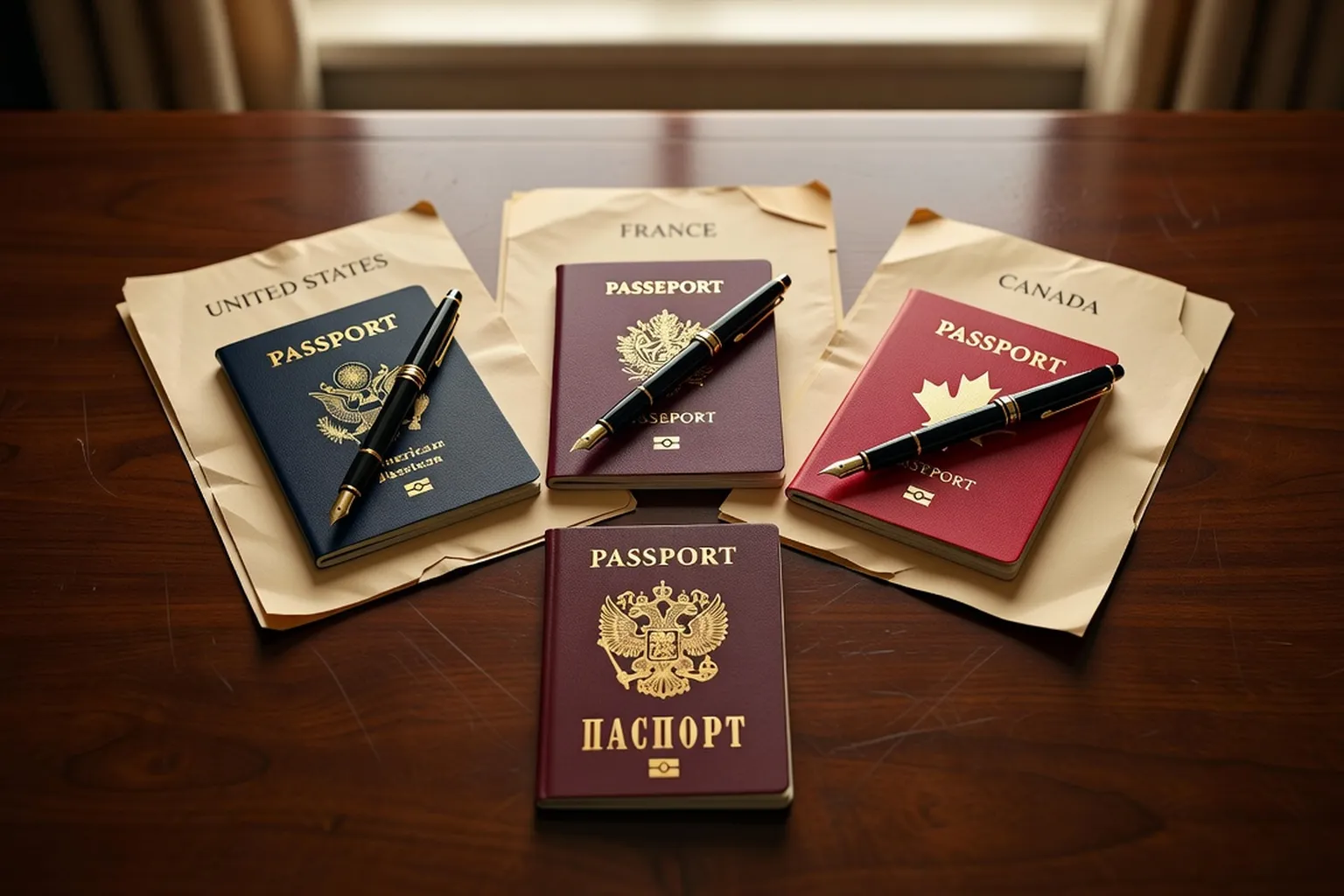
When a Western man and a Russian woman decide to marry, the choice of host country shapes the entire immigration trajectory. The USA, France, and Canada represent the three most common destinations for Russian fiancées in 2026, and each route has fundamentally different mechanics: different visas, different documents, different processing times, and very different post-arrival rights. Choosing the wrong route can add a year of waiting or thousands of euros in unexpected costs.
This guide compares the three routes side by side as they stand in 2026, with up-to-date processing times, fee structures, and risk factors. It is intended for couples weighing options at the planning stage and for serious matrimonial agencies advising clients on which country to optimize for.
Route 1: USA K-1 fiancée visa
The K-1 visa is a fiancée visa, not a marriage visa. The American citizen petitions for his Russian fiancée from inside the USA, the petition is reviewed by USCIS, then transferred to the appropriate American embassy for the consular interview. After approval, the fiancée enters the USA and the couple has exactly 90 days to marry inside US territory.
The total timeline in 2026 runs 14 to 22 months from filing the I-129F petition to the fiancée’s arrival. The post-2022 reality has added complications: Russian applicants are no longer interviewed at the Moscow embassy and must instead transit to Warsaw, Belgrade, or sometimes Astana for the consular interview. This adds logistical cost and time, and requires the woman to obtain a Schengen or Serbian or Kazakh transit visa.
Total budget: approximately $4,000 to $6,000 USD including USCIS fees ($535 for the I-129F, $265 for the embassy consular fee, $325 to $1,225 for the Adjustment of Status filing after marriage), medical examination at an approved panel physician ($300 to $500), translations and legalizations ($500 to $1,000), and travel for the consular interview ($1,000 to $2,000). Specialist immigration lawyer fees add $2,000 to $4,500 for a complete K-1 plus Adjustment of Status package.
Post-arrival rights are limited initially. The K-1 holder cannot work until she files an EAD (Employment Authorization Document) as part of the Adjustment of Status, which typically takes 3 to 6 months after marriage. She is not eligible for federal healthcare programs and depends on her American spouse’s employer-provided health insurance. Permanent residence (green card) is conditional for the first two years and becomes unconditional only after a successful I-751 joint petition. Our complete guide to the K-1 visa for Russian fiancées walks through the I-129F dossier preparation in detail.
The K-1 makes sense when the couple wants to marry in the USA (often for family reasons), when the American citizen cannot easily travel to Russia or to a third country for a civil ceremony, or when the couple wants to lock the relationship into the US legal framework from the earliest possible moment. It is the slowest of the three routes and the most expensive in legal costs.
Route 2: French visa long séjour conjoint or pacsé
France offers two principal routes for a Russian woman marrying a French citizen. The first is the visa long séjour conjoint de Français, granted after a civil marriage performed either in France or in Russia and then transcribed to the French civil registry. The second is the visa long séjour pacsé, for couples in a civil union (PACS) rather than marriage.
The French route is the fastest of the three in 2026: 4 to 8 months from visa application to the woman’s arrival on French soil. Many couples accelerate the process by first marrying in Russia (a 30-day civil registry process in Moscow or Saint Petersburg), having the marriage transcribed at the French consulate, and then applying for the visa as spouse of a French national. The transcription is the longest part of the process — count 3 to 6 months for the French civil registry to validate a foreign marriage.
Total budget: €2,000 to €3,500 covering the French long-stay visa fee (€99 currently), translation and legalization of Russian documents through apostille (€300 to €600), the consular interview travel, and the medical examination required upon arrival in France for the residence permit. Lawyer fees are usually unnecessary for a straightforward spouse visa; couples with complications (previous refusals, prior immigration issues) should budget €1,500 to €3,000 for a specialist avocat en droit des étrangers.
Post-arrival rights are immediate and generous. The visa long séjour valant titre de séjour grants the woman a one-year residence permit upon arrival, with full work authorization, immediate enrollment in the French health insurance system (Sécurité sociale) after three months of residence, and access to the labor market without sector restrictions. The residence permit is renewable annually and converts to a multi-year permit after three years. Naturalization is possible after four years of marriage and continuous residence. The interview with our family lawyer on Franco-Russian marriage details the residency framework comprehensively.
The French route makes sense when the couple plans to settle in France long term, when the woman has career ambitions she wants to pursue with full work rights from day one, or when the cost of the K-1 is prohibitive. It is the most balanced route in 2026: moderate cost, fastest processing, and most generous post-arrival framework.
Route 3: Canadian spousal sponsorship
Canada offers two main spousal sponsorship pathways: outland sponsorship (the woman remains in Russia or a third country until the application is approved) and inland sponsorship (the woman is already in Canada on a valid visitor or other visa when sponsorship is filed). For Russian fiancées entering Canada for the first time, outland sponsorship is the standard route.
The Canadian timeline in 2026 runs 12 to 18 months from filing the sponsorship application to the woman’s arrival in Canada with permanent resident status. This is faster than the K-1 because the Canadian system grants permanent residence directly at the visa stage, not conditional residence that must be upgraded later. The Russian applicant attends biometrics in Moscow or in a third country and may be called for an embassy interview in Moscow if the file raises questions.
Total budget: CAD $3,500 to $5,000 covering IRCC sponsorship application fee ($1,205 CAD), right of permanent residence fee ($575), biometric collection ($85), medical examination at an approved panel physician (CAD $300 to $500), and translation and legalization of Russian documents (CAD $400 to $800). Specialist immigration consultant or lawyer fees add CAD $2,000 to $4,500 if used.
Post-arrival rights are the most generous of the three countries. The Russian wife arrives as a permanent resident, meaning she can work immediately in any sector, qualify for provincial health coverage (with a brief waiting period that varies by province), enroll in Canadian language training programs free of charge, and access most social services. Canadian citizenship is available after three years of physical residence within a five-year window. The CQMI agency in Quebec specializes in Franco-Russian marriages with Canadian relocation and provides detailed guidance on the Quebec-specific selection certificate (CSQ) that applies to fiancées settling in Quebec province.
The Canadian route makes sense for French-speaking Russian women (who can take advantage of Quebec immigration), for couples wanting maximum post-arrival flexibility, and for those willing to wait slightly longer than the French route for significantly more generous immigration status. It is the most family-friendly of the three routes in terms of post-arrival integration support.
Side-by-side comparison table
| Criterion | USA K-1 | France visa conjoint | Canada outland sponsorship |
|---|---|---|---|
| Processing time | 14–22 months | 4–8 months | 12–18 months |
| Total government fees | $1,125 USD | €99 | CAD $1,865 |
| Total budget incl. travel/translation | $4,000–$6,000 USD | €2,000–€3,500 | CAD $3,500–$5,000 |
| Marriage required before visa | No | Yes (civil) | Yes (civil) |
| Post-arrival work right | After EAD (3–6 months) | Immediate | Immediate |
| Health coverage | Spouse insurance | Sécurité sociale (3 months) | Provincial (variable wait) |
| Permanent residence | Conditional 2 years then I-751 | After 4 years total | Immediate upon arrival |
| Naturalization possible after | 3 years marriage | 4 years marriage | 3 years residence |
| Refusal rate 2026 | 20–25% | 10–15% | 15–20% |
| Embassy for Russian applicants | Warsaw / Belgrade / Astana | Moscow (delayed) | Moscow (delayed) |
| Lawyer recommended | Strongly | Optional | Recommended |
Which route for which couple
Couples choose between the three routes based on three primary factors: where they intend to settle long term, how much time and money they can invest in the immigration process, and how much risk tolerance they have for refusal.
A French citizen marrying a Russian woman should default to the visa long séjour conjoint unless there is a specific reason to relocate to North America. The French route is faster, cheaper, and grants the most immediate work and health rights for the cost.
An American citizen has two real choices: the K-1 fiancée visa for couples who want to marry in the USA, or the spousal CR-1 visa for couples who marry in Russia or a third country first and then apply for permanent residence. The CR-1 takes longer but grants permanent residence on arrival, avoiding the EAD bottleneck. Either way, the American route is the slowest and most expensive.
A Canadian citizen should default to outland spousal sponsorship for the strongest post-arrival framework. Quebec residents have the additional CSQ step but gain access to the Quebec-specific French language training and integration programs that significantly accelerate the wife’s adaptation. For couples considering whether to work with a Russian or Ukrainian matrimonial agency before the visa step, the legal framework in Canada applies identically to both Russian and Ukrainian fiancées.
Common dossier mistakes that cause refusal
Refusal of a fiancée or spouse visa is rarely random. Most refusals fall into a small number of predictable categories. First, insufficient evidence of a genuine relationship: visa officers in all three countries look for photos across multiple meetings, correspondence over at least a year, travel records showing reciprocal visits, and shared financial documents if applicable. A dossier built on three weekend visits and a few months of WhatsApp exchanges raises immediate doubt.
Second, financial inadmissibility on the sponsor side. The USA requires a sponsor income of at least 125 percent of the federal poverty guideline for the household size. Canada requires the sponsor to commit to a financial undertaking for three years. France requires proof of sufficient resources to support the spouse without recourse to social assistance. Sponsors who do not meet these thresholds should plan well in advance to build co-sponsor or asset documentation.
Third, incomplete or incorrectly translated Russian documents. Russian civil registry documents (birth, marriage, divorce certificates) must be apostilled in Russia, then translated by a certified translator in the destination country. Missing apostille or non-certified translation is the single most common cause of file return for additional documentation, adding two to four months of delay.
Fourth, prior immigration violations or refusals. Any prior US visa refusal, French OQTF (obligation de quitter le territoire), or Canadian inadmissibility ruling will surface in the database review. Couples with such history must address it transparently in the application and usually require a specialist lawyer.
The verifying a Russian fiancée’s profile online guide covers the upstream verification work that should be completed before the visa step even begins.
The right immigration route depends on the couple’s long-term project, not on the speed or cost alone. France is best for European settlement and immediate integration. Canada is best for permanent residence and family flexibility. The USA K-1 makes sense when the marriage must happen on American soil but otherwise lags in speed and cost-efficiency.
For couples still in the matchmaking phase, the CQMI Franco-Russian matrimonial agency in Quebec and topdatingreviews.com independent reviews cover the upstream agency selection that precedes the visa decision by twelve to eighteen months.
Frequently Asked Questions
Which country is fastest for bringing a Russian fiancée: USA, France, or Canada in 2026?
France is currently fastest in 2026. The French visa long séjour conjoint or pacsé typically takes 4 to 8 months from application to arrival, assuming a clean dossier. The Canadian outland spousal sponsorship takes 12 to 18 months. The American K-1 fiancée visa takes 14 to 22 months including the embassy interview. France is faster largely because the process can begin after a civil marriage performed abroad, while the K-1 requires the marriage to happen on US soil within 90 days of arrival.
Which country offers the best post-arrival rights for a Russian wife?
Canada offers the most generous post-arrival rights: the sponsored spouse can work immediately upon arrival, access universal health care after a brief wait, and apply for permanent residence as part of the same sponsorship file. France grants a renewable one-year residence permit with full work rights and immediate access to the French health system. The USA K-1 visa offers fewer immediate rights: the new spouse must wait for the Adjustment of Status to file an EAD (work permit), which can take 3 to 6 months.
What is the total budget for a Russian fiancée visa to USA, France, or Canada in 2026?
France: between €600 and €1,500 in government fees plus translation, legalization, and travel — total around €2,000 to €3,500. USA K-1: approximately $2,500 USD in USCIS and embassy fees plus the medical exam and translations — total $4,000 to $6,000 USD. Canada outland sponsorship: approximately CAD $1,500 in IRCC fees plus medical, biometrics, and translation — total CAD $3,500 to $5,000. Excluding lawyer fees, which range from €1,500 to €5,000 depending on the route.
Do you need a lawyer to file a Russian fiancée visa in 2026?
Not legally required for any of the three routes, but recommended for the K-1 and Canadian sponsorship because of dossier complexity and the cost of refusal. The French visa long séjour conjoint is the simplest and most predictable: many couples successfully apply without a lawyer if they have a clean file and a real marriage proven by photos, correspondence, and travel records. A specialized lawyer dramatically reduces refusal risk for the K-1 and Canadian routes.
Can a Russian woman still travel to a US, French, or Canadian embassy in 2026?
Yes, but the embassy options have shifted since 2022. For the K-1 visa, the US embassy in Moscow no longer processes visas; Russian applicants are routed to US embassies in Warsaw, Belgrade, or Astana. France maintains its consular service at the embassy in Moscow with longer than normal delays. Canada also processes through Moscow but with consular delays. Most agencies coordinate the embassy logistics for clients, including transit visas if needed for the consular country.
What is the refusal rate for a Russian fiancée visa in each country in 2026?
France: refusal rate around 10 to 15 percent for spouse visas of French nationals, lower if the marriage was performed in France. USA K-1: refusal rate around 20 to 25 percent for Russian applicants since 2022, due to increased Administrative Processing 221(g) reviews. Canada: refusal rate around 15 to 20 percent for outland sponsorship, mostly due to inadmissibility on financial grounds or incomplete documentation. A clean dossier with proof of genuine relationship and stable sponsor financials reduces refusal risk to under 5 percent in all three countries.